

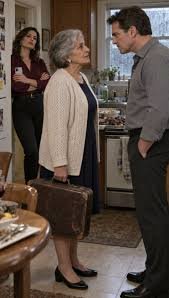
“What paperwork?”
Henry answered without looking away from David. “Permission to occupy the property without rent as long as Catherine wished. It states explicitly that residency creates no ownership interest.”
Emily stared at her husband as though his features had rearranged themselves.
“You knew.”
David reached for the page.
Henry covered it with one hand.
“A copy is fine. This one stays with me.”
“Get out of my house.”
The sentence escaped David before he understood what he had said.
Henry’s expression did not change.
I felt Alice watching from the sofa. Peter had put one arm around his sister, imitating the way I held them during thunderstorms.
“You keep using that word,” I said.
David looked at me, and for a moment I saw the frightened boy who used to hide broken toys beneath his bed. But he was no longer a boy, and this was not a lamp he could blame on someone else.
“I built a life here.”
“So did I.”
“You have one bedroom.”
I swallowed. “You made sure of that.”
Emily began pacing between the sofa and the kitchen. Her heels clicked against the floor I had scrubbed that morning.
“All this time,” she said, “you let me renovate a house you didn’t own?”
“We were going to own it eventually.”
“According to whom?”
David looked toward me.
The answer was there before he spoke it. According to his expectation that I would eventually die. According to the future he had already arranged around my absence.
Emily understood. Her hand rose to her throat.
“Oh my God.”
“Don’t make it sound like that.”
“What should it sound like?” I asked.
David’s gaze snapped back to me. “You always said everything would be mine someday.”
“Someday is not today.”
The muscles in his face tightened.
“So what now? You throw your grandchildren into the street to prove a point?”
There it was—the weapon he had expected me to hand him simply because I loved those children.
My first instinct was to retreat. I could already imagine Peter’s frightened questions, Alice packing her stuffed rabbit, neighbors watching boxes leave the driveway. David knew exactly where to press because I had spent his entire life shielding him from consequences.
Henry said nothing. He did not rescue me from the choice.
That kindness was harder than intervention.
I walked into the living room and sat on the edge of the armchair across from Peter and Alice. Alice leaned forward, but waited.
“Neither of you has done anything wrong,” I told them. “You will have a safe place to sleep. You will have food, school, and people who love you. The adults are going to make some changes, but those changes are not your fault.”
Peter looked past me toward his father.
“Did Dad lie about the house?”
David stepped forward. “Peter—”
“Yes,” I said.
The word hurt me as it left. It also freed something.
Peter’s eyes filled, not because of the property, but because children know when the shape of a parent has changed in front of them.
Emily came around the sofa. As she lifted a hand to smooth his hair, the sleeve of her blouse slid back.
Gold caught the afternoon light.
My grandmother’s bracelet circled her wrist.
For three years, I had wondered whether grief and age had made me careless. I had emptied drawers, checked coat pockets, opened the wooden box again and again. I had almost apologized to Emily for privately suspecting her.
Now the tiny engraved roses rested above her crimson nails.
“Take it off,” I said.
