

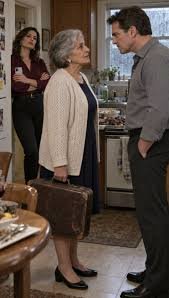
Henry removed the first document and unfolded it carefully.
“No. It’s recorded.”
Emily’s gaze darted toward David. “You said the house was yours.”
“It is.”
“Then show him.”
David did not move.
Henry laid the document flat. I recognized Albert’s signature near the bottom, bold and slightly slanted, beside mine. Above it was the address of the house where I had spent three years asking permission to turn up the heat.
“Catherine is the sole legal owner,” Henry said. “You have been living here because she allowed it.”
The refrigerator motor clicked off. In the sudden quiet, I could hear David breathing through his nose.
“Mom knew?” he asked.
“Of course she knew.”
David turned toward me so quickly that his shoulder struck the edge of the door.
“You let us pay for repairs. You let me replace the roof.”
“You used the household account for the roof,” I said. “The account I funded after selling my condo.”
His mouth opened, then closed.
Emily stared at him. “You told me the condo money went into the second store.”
“Most of it did.”
“Most?”
“This isn’t the time.”
Her crimson nails pressed into the case of her phone. “It became the time when a man arrived with the deed to the house you just threw your mother out of.”
David’s embarrassment sharpened into anger. It was the emotion he reached for whenever shame came too close.
“Fine. Her name is on an old piece of paper. That doesn’t change what’s practical. She can’t maintain a place this size. She needs supervision, and we need room for the children.”
“I cook your food,” I said. “I drive your children. I manage your appointments, your laundry, and half the bills you forget to pay. Which part of that suggested I need supervision?”
He rubbed a hand across his mouth.
“You’re twisting this.”
“No,” Henry said. “She’s finally saying it plainly.”
Footsteps sounded on the staircase.
Peter appeared first, one hand wrapped around the banister. Alice stood behind him in pink socks, clutching the stuffed rabbit she carried when adults raised their voices.
David’s posture changed immediately.
“Go upstairs.”
Neither child moved.
Peter looked at my suitcase. “Grandma, are you going somewhere?”
I could have lied to protect David. The instinct rose before I could stop it, old and familiar: soften the truth, preserve the father in his children’s eyes, carry the hurt somewhere private.
Then I remembered Peter whispering that I was only staying for now. He had already been carrying secrets adults had placed upon him.
I set down the suitcase.
“Your father asked me to leave.”
Alice’s fingers tightened around the rabbit’s ear.
“But you live here.”
“She’s confused,” Emily said quickly. “No one is throwing anyone away.”
I turned to her. “That is exactly what happened.”
“Catherine, not in front of the children.”
“You discussed turning my bedroom into a closet loudly enough for Peter to hear. Don’t ask for privacy now because the truth sounds ugly.”
Peter lowered his eyes.
David pointed toward the stairs. “Both of you. Now.”
Peter’s chin trembled, but he stepped down instead of up. He crossed the entryway and stood beside my suitcase.
“I don’t want Grandma to go.”
The words were quiet. They landed harder than shouting.
David’s hand fell to his side.
Alice came down next. She slipped her small hand into mine without asking what the adults had decided, and the simple trust of it nearly undid the control I had held all afternoon.
I bent and kissed the top of her head.
“Go sit in the living room with Peter, sweetheart.”
This time, the children listened. Peter took Alice’s hand, but both remained close enough to hear.
Henry waited until they were seated before lifting a second page from the envelope.
“There is also the occupancy agreement Albert prepared before his death and Catherine renewed when David’s family moved in.”
David’s face shifted.
It was small—only a tightening at the corners of his eyes—but Emily saw it.
“You know that document,” she said.
“It was paperwork.”
