

Emily stopped.
“What?”
I rose slowly. “The bracelet. Take it off.”
Her other hand covered it.
“David gave this to me.”
Every face turned toward him.
David’s shoulders dropped by less than an inch.
“Mom wasn’t wearing it,” he said. “It was sitting in a box.”
The floor seemed to tilt beneath me.
Not Emily alone.
My son had opened the wooden box, lifted the bracelet my grandmother wore through forty-three years of marriage, and decided my memories were unused property.
“You took it?” I asked.
“I thought Dad bought it for you.”
“You knew he didn’t.”
“It’s a bracelet.”
Peter stood up.
“Dad.”
David turned. “Stay out of this.”
“You said Grandma lost it.”
No one moved.
Peter’s voice shook. “You said she kept forgetting things, and that was why she couldn’t live here much longer.”
The words opened the deepest wound of the afternoon.
David had not merely taken something from me. He had used its disappearance as proof that I was failing.
Emily looked down at the bracelet as though it had tightened around her wrist.
“You told me she gave it to us.”
David’s face flushed. “I was going to explain.”
“When?” she asked. “After she was in a nursing home?”
He reached for her arm, but Emily stepped back.
That single movement changed the room. Until then, she and David had stood together, each strengthening the other’s version of events. Now there was space between them, and into that space came everything they had avoided saying.
Emily struggled with the clasp. Her fingers trembled so badly that Henry finally held out his handkerchief. She used it to grip the small catch, then placed the bracelet in my palm without meeting my eyes.
It was warm from her skin.
“I didn’t know he took it,” she said.
“You knew it was mine when you wore it in those photographs.”
Her gaze lifted, then fell again.
“I suspected.”
“And that was enough for you.”
She had no answer.
I closed my fingers around the bracelet. Anger would have been easier. What moved through me was grief—grief for my grandmother, for Albert, and for the son who had learned that my silence could be converted into whatever story served him.
David turned on Henry.
“You came here to turn everyone against me.”
“You managed that without assistance.”
“Mom called you because she wanted a spectacle.”
I looked toward the open front door. A breeze stirred the edge of the deed on the entry table.
“I called Henry because I was afraid I would lose my courage.”
The admission quieted him more effectively than accusation.
“I knew what you had become,” I continued. “I just kept hoping you would remember who you were. Every meal, every shirt, every school pickup—I told myself kindness might bring my son back.”
David’s eyes shone, but his voice remained hard.
“So this is revenge.”
“No. Revenge would be giving you the same amount of time you gave me.”
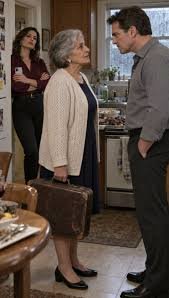
I crossed to the entryway and placed my suitcase beside Henry’s envelope.
“You and Emily will have sixty days to find another home. During that time, you will pay the utilities and treat this house—and me—with respect. If either of you threatens me, removes my belongings, or tells the children I caused this, the permission ends sooner.”
Emily sank onto the edge of the sofa.
David stared as though he had not understood the words.
“You’re evicting us.”
