

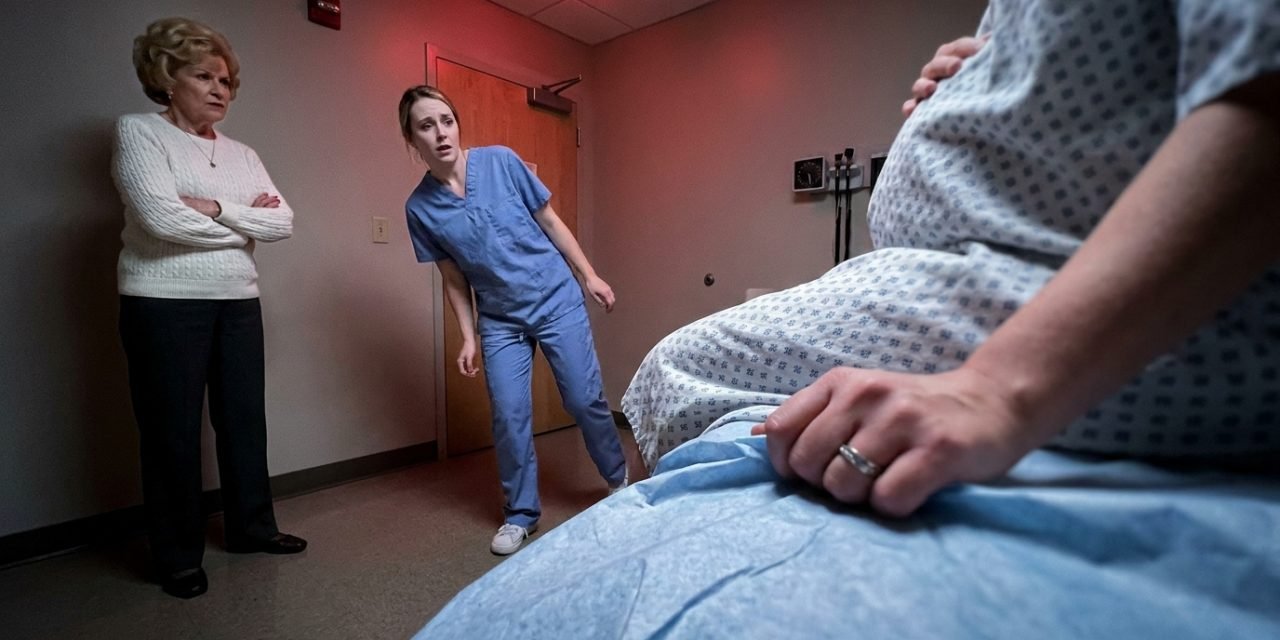
The paper covering the examination table crinkled loudly under my weight every time a new shiver racked my body.
I sat near the edge, my hands resting protectively over my massive, thirty-four-week pregnant belly. The air conditioning in the Oak Creek Maternity Clinic was set to a freezing, aggressive hum, blowing directly down from a vent above my head. But the cold air did nothing to dry the thick layer of sweat rolling down the back of my neck.
My breath came in shallow, ragged little gasps. The pain in my left calf had evolved over the last twenty-four hours. It wasn’t just a dull ache anymore.
It was a sharp, rhythmic burning that seemed to pulse in perfect synchronization with my racing heartbeat. It felt heavy. It felt entirely wrong.
“Stop fidgeting, Maya,” Helen’s voice snapped from the corner of the room.
I slowly turned my head. My mother-in-law was sitting perfectly upright in the cheap plastic visitor’s chair. Her posture was as rigid as a steel rod.
She wore a pristine white cashmere sweater and tailored gray slacks, her expensive leather handbag resting neatly on her lap. Her blonde hair was sprayed into an immovable helmet of perfection. She looked entirely out of place in this small, public clinic, and her face clearly showed her disgust for the scuffed linoleum floor.
But her eyes were not on the room. They were fixed entirely on my left leg.
“I’m not fidgeting, Helen,” I whispered. My throat felt like sandpaper. “It hurts. It really hurts.”
“Pain is a part of motherhood,” Helen replied coldly. She didn’t blink. “You need to build a higher tolerance if you’re going to survive labor. Whining won’t help the baby.”
I squeezed my eyes shut, trying to bite back the tears of sheer frustration and physical agony.
I was completely alone with her. My husband, Mark, was three thousand miles away on a corporate business trip in London. He had left two days ago, kissing my forehead at the door and promising to be back before the baby dropped any lower.
Helen had insisted on moving into our house for the final month of my pregnancy. She claimed she needed to help prepare the nursery and support her grandbaby. I hadn’t wanted her there. Mark had practically begged me to just let her stay, saying it would keep the peace.
From the exact moment Mark’s Uber pulled out of our driveway, she had taken over my entire life.
She controlled what I ate, physically pulling a plate of pasta away from me at dinner because it had too many carbohydrates. She controlled when I slept, walking into the living room and unplugging the Wi-Fi router at nine o’clock every night.
And yesterday afternoon, she had controlled the accident.
I had gone down to the unfinished basement to retrieve a sealed box of newborn onesies. The lighting down there was poor, just a single bare bulb hanging from a pull chain. The concrete floor was cluttered with Mark’s old tools, loose screws, and scraps of metal from a woodworking phase he had abandoned years ago.
I hadn’t even seen what I stepped on.
I just felt a sudden, agonizing pierce. Something thick and jagged drove directly into the side of my left calf, biting deep into the muscle.
I screamed, dropping the plastic storage bin. I collapsed onto the dusty concrete floor, clutching my leg. The pain was blinding, hot, and immediate.
Helen had rushed down the wooden stairs faster than I had ever seen a woman her age move.
When she saw the dark blood pouring from my leg, pooling on the gray floor, I begged her to call an ambulance. My chest was heaving. I was terrified the shock and the pain would send my body into early labor.
But Helen had simply stared at the wound.
“Hospitals are filled with diseases, Maya,” she had scolded me, grabbing my upper arm. Her grip was startlingly strong. “Do you want to expose my grandson to a staph infection? I will handle this.”
She had practically dragged me up the stairs. I was sobbing, limping, leaving a trail of red spots on the carpet.
She forced me to sit on the cold bathroom tiles. Then, she disappeared into the kitchen and came back with a cup of dark, bitter-tasting herbal tea. She claimed it would calm my nerves and stop the Braxton Hicks contractions I was starting to feel.
I didn’t want to drink it. It smelled like wet dirt and copper. But the pain in my leg was so overwhelming, and she was standing over me with such aggressive authority, that I forced it down just to make her stop shouting.
Ten minutes later, the bathroom walls had started to tilt. The world went black.
When I finally woke up in my own bed this morning, my head was spinning in a heavy, narcotic fog. My mouth tasted like ash.
My left leg was propped up on three pillows. It was wrapped in a massive, incredibly thick bandage made of heavy white medical gauze.
But it wasn’t secured with normal medical tape.
Helen had wrapped it tight with thick, black electrical tape. She had wound the black plastic round and round my calf, pulling it so tight it indented my swollen skin. It looked completely barbaric.
“I cleaned it, stitched it, and applied a traditional poultice,” Helen had told me. She was standing right at the foot of my bed, watching me wake up.
“Do not touch the bandage, Maya. The poultice needs a completely sealed environment to draw out the infection. If you take it off, the toxins will spread directly to the baby.”
I had been too weak, too dizzy, and too terrified to argue with her.
But by noon today, the localized pain in my leg had escalated into something monstrous. It didn’t feel like a simple cut anymore. It didn’t feel like stitches healing.
It felt like a deep, mechanical pressure. It felt like something was actively swelling and expanding underneath that tight black tape, fighting for space beneath my skin.
Worse than the pain was the smell.
