


The doctor’s silver pen did not touch my skin, but the shadow of it hovered just above my shoulder blade.
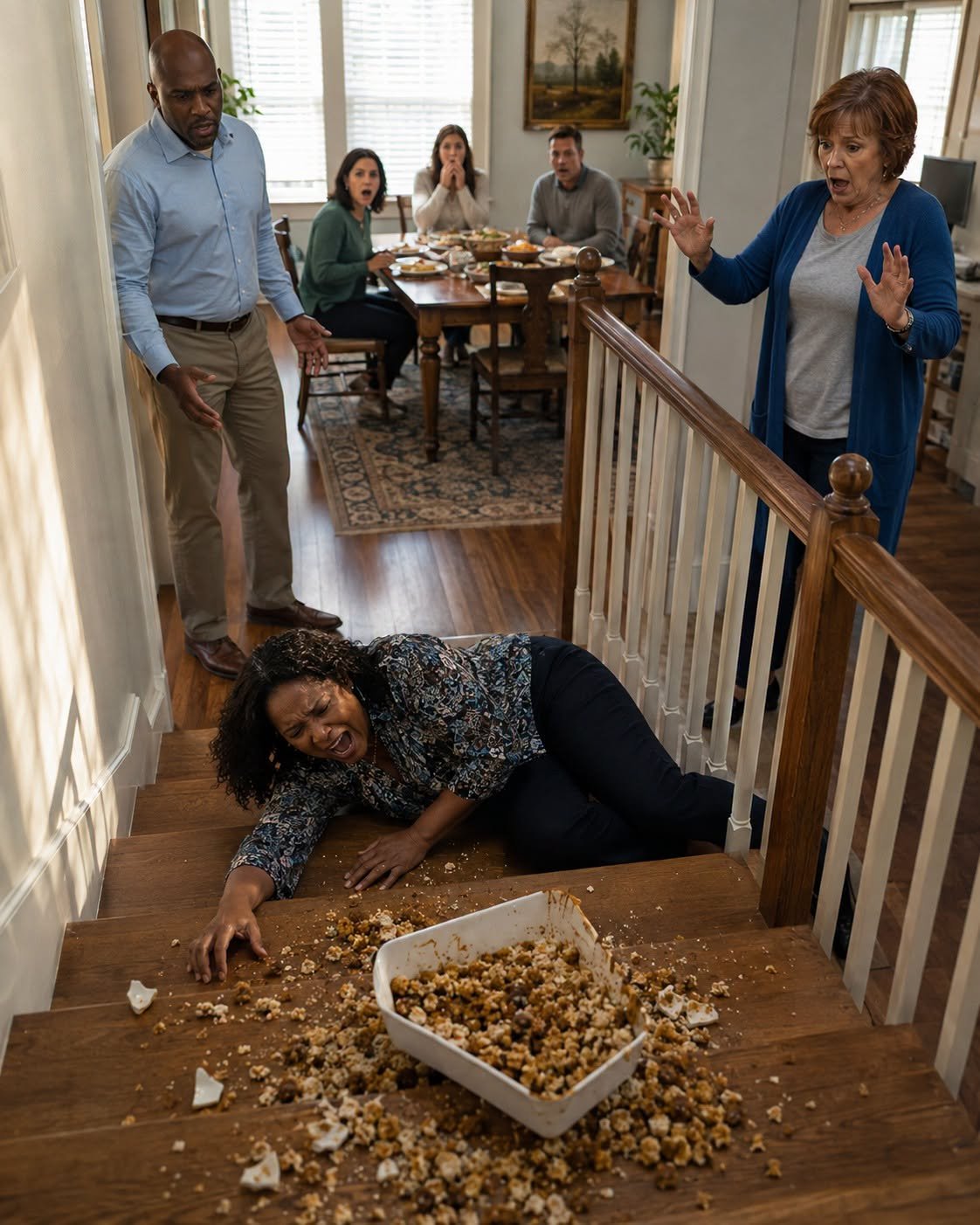
“There is a distinct, linear bruise forming here, Nora,” Dr. Mercer said. He pointed directly to my upper back with the pen. “Did you hit a railing on the way down?”
Graham stood by the heavy wood-look door of Room 3, his hands pressed flat together, palm to palm. He had his beige corduroy jacket on, the one with the frayed cuffs he wore for parent-teacher conferences at the high school.
“She was carrying the ceramic baking dish,” Graham said, his voice dropping into that soft, placating register he used when our cat got stuck behind the dryer. “The steps down to Judith’s basement are old pine. They get slick in October.”
I did not look at him, but I adjusted my watch strap, pulling the leather one notch tighter against my wrist. As a bookkeeper, I was used to things that balanced, columns that didn’t lie, numbers that stayed exactly where you put them on the ledger page.
The hospital gown was thin, and my cream cardigan lay folded on the bedside chair, the dark brown casserole stain near the hem already drying into a stiff, ugly crust.
Dr. Mercer did not look up from his metal clipboard. “A slip usually results in lateral bruising along the hip or the elbow, Graham. This looks like direct, concentrated pressure.”
“It was very dark on the landing,” Graham said. He pressed his palms together so hard his knuckles turned the color of lard.
“The light bulb was working,” I said.
The doctor paused, his silver pen frozen over the white paper. “Did you lose your footing, Nora?”
I looked at the blue privacy curtain hanging from its track.
“The floor was cold,” I said.
“We need to get the portable x-ray machine in here before we move you to a ward,” Dr. Mercer said. He tapped the pen twice against the metal board and stepped out to check a chart, leaving the door open just wide enough for the draft to reach my bare feet.
“Nora,” Graham said, taking a single step toward the bed. “I brought your green water bottle from the car, the one with the dent from our trip to Lake Michigan.”
“Put it on the table,” I said.
“My mother is outside in the waiting room,” he said.
He did not look at me when he said it, choosing instead to stare at the small pile of paper cups by the sink.
“She wants to know if you need her to go back to our place to feed the cat,” Graham said.
“The cat has enough dry food until tomorrow,” I said.
He pressed his back against the white wall, his shoulders hunching slightly under the corduroy.
“She feels terrible about the dish,” Graham said. “It was her mother’s.”
“It was a cheap glass casserole dish, Graham,” I said, clearing my throat before speaking about our finances. “We bought it at the hardware store in Oak Creek for nine dollars.”
He adjusted his glasses, his fingers lingering on the plastic frame.
“I just don’t want everyone to start shouting,” he said.
“Nobody is shouting,” I said.
The tall nurse with the graying hair came back into the room then, carrying a plastic tray with small cups of ice.
“We need to take her down the hall for the pressure check,” the nurse said.
“I will wait right here,” Graham said, his voice barely a whisper.
He did not offer to help me slide my feet into the paper slippers.
The hallway was much brighter than the room, the fluorescent lights reflecting off the yellow linoleum floor in long, clean strips.
The nurse, whose badge read Sarah, pushed my wheelchair with slow, steady steps past the double doors of the pediatric wing.
“How long have you two been married?” Sarah asked.
“Four years in June,” I said.
She stopped the chair next to a small desk where a computer monitor flickered with a list of names.
“He seems very concerned about the stairs,” Sarah said, wrapping the black cuff around my left arm.
I held my phone in my right hand, the screen dark and cold against my palm.
“He worried about them when we moved our winter coats down there,” I said.
“We live on Elm Street,” I said. “The house has a small yard. We’ve been renting it since Graham got the job at the high school.”
“My nephew goes there,” Sarah said, adjusting the Velcro on the cuff. “He says Mr. Graham is the only science teacher who doesn’t yell.”
“He doesn’t like yelling,” I said.
The phone buzzed twice, a short vibration that made my fingers twitch.
I looked down at the screen.
It was a text from Graham, sent three minutes ago from Room 3.
“Please let me explain before you talk to them,” the message read. “I saw her hand on your back.”
The nurse watched the little dial needle bounce backward on her gauge.
“Your blood pressure is one hundred and fifty over ninety-five,” she said.
“I usually run low,” I said, keeping my thumb flat over the glowing text.
She reached for a small plastic cup of water and set it on the laminate counter. “Is there someone we should call to take you home tonight, Nora?”
“My sister lives in Ohio,” I said.
She took my wrist between her fingers, her thumb searching for the pulse beneath my skin.
“Your husband is very anxious to get you checked out,” she said.
“He wants to go back to his mother’s house,” I said.
She didn’t answer, her eyes fixed on the second hand of the wall clock.
I decided then that I would not ask Graham for permission to speak to the doctor.
“Let’s get you back to the room,” Sarah said, unlocking the wheels of the chair. “Dr. Mercer wanted to see if those films came back from the basement lab.”
When we got back to Room 3, Judith was already sitting in the vinyl chair by the window.
She had her dark wool coat draped over her knees, but she had not taken off her leather driving gloves.
“The floor here is filthy,” Judith said, tapping the toe of her leather boot against the metal baseboard. “You would think a county hospital could afford a mop.”
“Mother, please,” Graham said, his voice dropping into that placating tone again.
Judith ignored him, looking at the plastic pitcher on my bedside table. “Did they even offer you anything warm to drink? I told Graham we should have brought the thermos from the kitchen, but he was in such a rush to get the car keys.”
She looked from the pitcher back to my hospital gown, her eyes resting on the stained cream cardigan. “The doctor said they might keep you for observation. On a Sunday night, of all times.”
“The stairs are very steep, Judith,” I said, clearing my throat before I spoke about the medical bill. “The ambulance ride alone will be over twelve hundred dollars.”
“You always did have trouble with those heels, Nora,” Judith said, brushing a speck of gray lint off her wool trousers with a sharp, downward flick of her gloved finger. “A sensible shoe would have caught on the tread.”
