

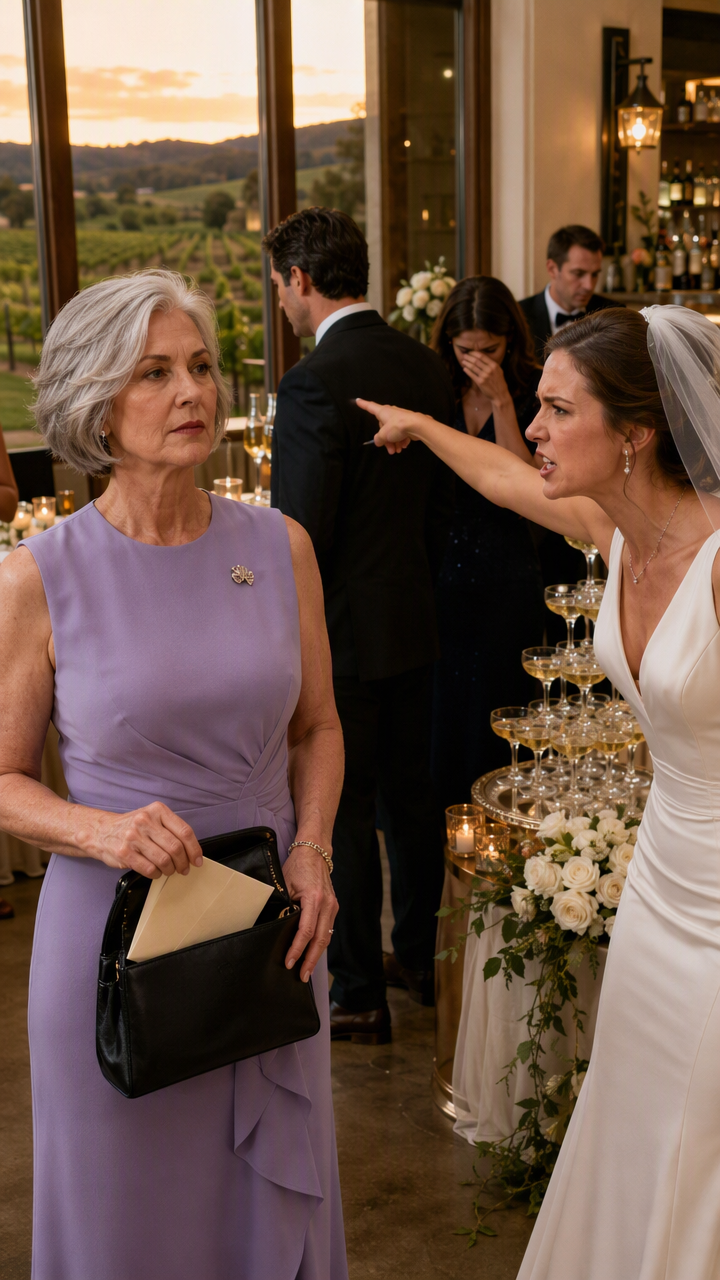
The first thing Brooke did after humiliating me in front of nearly two hundred wedding guests was ask whether I had remembered to pay the final balance.
I will never forget that detail.
Not her veil trembling in the candlelight. Not the way every conversation in the reception hall died at once. Not even my son Ethan standing beside his bride with his hands folded in front of him, staring at the bottles behind the bar as if the labels contained instructions for what to do with an unwanted mother.
It was the venue manager’s question that stayed with me.
“Mrs. Miller,” he said nervously, “the remaining balance is due before dinner service begins.”
Brooke turned toward him.
“She’ll take care of it,” she said.
Then she looked at me and smiled without warmth.
“Won’t you, Judith?”
I was seventy-three years old. I was a widow. I had paid forty-six thousand dollars toward the wedding of the only child I had ever had.
And suddenly, I was being treated like an embarrassing stranger who had wandered into the wrong party.
I looked at Brooke’s white veil, at the diamond earrings I had helped pay for, at the flowers I had chosen after she rejected six other arrangements.
Then I looked at Ethan.
He was thirty-eight years old, six feet tall, broad-shouldered, and silent.
When he was seven, he used to wake screaming from nightmares. I would sit beside his bed, rub his back, and stay awake until morning. Once, after I made him buttered noodles at two in the morning, he drew a picture of me wearing a crooked red cape.
In one hand, I held a wooden spoon like a sword.
Underneath, in large uneven letters, he had written:
MOM FIXES EVERYTHING.
I kept that drawing for almost forty years.
That morning, before driving to Rosewood Vineyards Estate, I had folded it carefully and placed it inside my handbag.
I had also placed something else there.
A sealed cream envelope.
Three months earlier, Ethan had called me to announce his engagement.
“Her name is Brooke,” he said. “She’s confident. Organized. You’ll like her.”
I heard the pause before the next sentence.
“We found the perfect venue in Napa Valley, Mom. It’s just… expensive.”
He did not ask me for money.
Ethan had perfected the art of making requests sound like accidents.
Two days later, a packet arrived from Rosewood Vineyards Estate. It included the reception hall, catering, flowers, wine selection, photographer, music, chair rental, and the first payment on Brooke’s dress.
The first installment was $46,000.
I signed the wire authorization.
When the money cleared, Brooke called me.
“Judith, thank you,” she said. “You’re making our dream wedding possible. Ethan always says you’re extraordinary.”
Her words sounded less like gratitude than confirmation that the payment had gone through.
After that, I became an invoice with a heartbeat.
“Mom, can you approve the menu change?”
“Judith, Brooke wants imported champagne.”
“Mom, the photographer needs to be paid today.”
Never, “How are you?”
Never, “Would you like to come over?”
Never even, “How are you managing since Dad died?”
I had raised Ethan alone for nearly nine years after Henry passed away. I had worked at a hospital billing office during the day and cleaned offices three nights a week. I had sold my wedding ring to pay for Ethan’s first semester of college.
I did not resent those sacrifices.
What hurt was that Ethan remembered them only when he needed another one.
The seating chart arrived a week before the wedding.
My name was at Table Nine, behind a thick column beside the kitchen doors.
I called Brooke.
“Is there some mistake?” I asked.
“No.”
Her answer came so quickly that I knew she had expected the question.
“The arrangement works better for the photographs,” she continued. “The symmetry is essential. Thanks for understanding.”
Understanding.
That was the word people used when the decision had already been made and you were expected to disappear gracefully.
A week before the ceremony, I picked up the lavender dress Brooke had chosen for me. It was sleeveless, stiff, and far too thin for an October evening.
The salesclerk lowered her eyes when I tried it on.
“It’s exactly the model the bride requested,” she murmured.
That night, I opened Henry’s old notebook.
My husband had recorded everything in pencil: household expenses, gifts, school plays, Ethan’s first bicycle, and the dates he paid the mortgage.
On the last page, beneath a list of funeral costs, Henry had written one sentence.
Don’t let generosity become permission.
I read it three times.
Then I called my attorney.
Her name was Margaret Shaw, and she had been Henry’s closest friend since law school. I told her everything: the money, the seating chart, Brooke’s coldness, Ethan’s silence.
Margaret listened without interrupting.
When I finished, she asked, “Do you want me to stop the remaining payments?”
I stared at the lavender dress hanging on my closet door.
“No,” I said. “Not yet.”
“Judith, you are not required to purchase a front-row seat to your own humiliation.”
“I know.”
“Then why are you going?”
I thought about Ethan’s crooked drawing.
“Because I need to see who he becomes when no one believes I can take anything away.”
There was a long silence.
Then Margaret said, “I’ll prepare the papers.”
“What papers?”
“You’ll know when the time comes.”
At Rosewood Vineyards Estate, the hills were covered in gold and rust-colored vines. White roses climbed the stone walls. A string quartet played beneath a canopy while servers carried champagne through the crowd.
Everything was beautiful.
