

## Part 8: The List of Twenty-Seven
Elena Vasquez called a meeting at her office with Sam Whitfield, and for three hours we built the list. Not the twelve from the crossed-out inventory. Not the nine from the gallery website. The full list, from my photographs, from Harold's receipts, from the bank deposits, from the gallery's archived pages, from a second collector Sam had found in Texas who had bought two of my paintings and wondered why the certificates looked freshly printed.
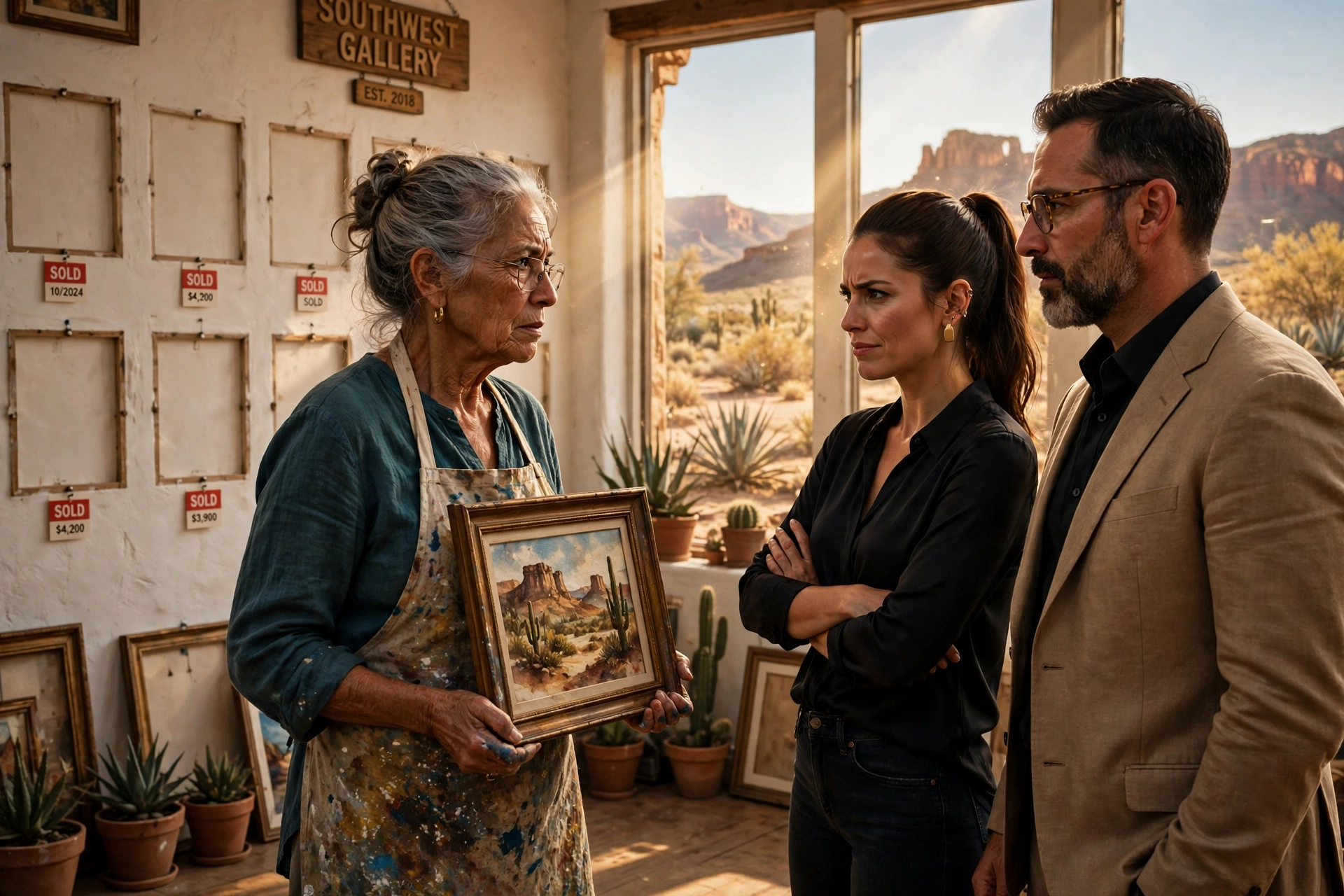
Twenty-seven paintings. Twenty-seven pieces of my life, sold for a total of more than $612,000, of which I had received nothing. Some had been sold for far less than they were worth, quickly, to move them fast. Others had been sold for high prices to collectors who believed they were buying directly from a respected artist through a respected gallery. The money had moved from the gallery to the Scottsdale account, then to Canyon Light Holdings, then out again in payments to Trent, to Candace, and to Ray — and to a fourth name Sam had not yet identified, someone who received regular payments labeled only as "consulting."
"Consulting," Elena said, tapping her pen against the table. "That's how people hide a partner. We will find out who that is."
Sam had also found something else: a second gallery, in Scottsdale, with a different name — Desert Light Fine Art — that had sold at least six of my paintings under slightly changed titles. "Winter Light on the Rio Grande" had become "Rio Grande in Winter." "Sage After Fire" had become "After the Fire." Small changes, just enough to make the paintings harder to search for online, just enough to confuse a collector who tried to check.
"They were counting on you never looking," Elena said. "They were counting on you being a painter, not a businesswoman. They were wrong about that, Mrs. Calloway, and we are going to prove it."
Elena sent formal letters to Trent, to Candace, and to Ray, demanding the return of all unsold paintings, a full accounting of every sale, and the cancellation of the HELOC. She also filed a notice with the county recorder, warning any bank or buyer that the HELOC signature was disputed. And she filed a copyright registration for my entire body of work, with the photographs as evidence, so that no one could claim I did not own the images.
The letters did not bring an apology. They brought a phone call from Candace, late at night, from a number I did not recognize. She was crying, but it was not the soft crying of a sorry person. It was the sharp, angry crying of someone who has been caught.
"Mom, you hired a lawyer?" she said. "You called the police on your own daughter? Do you know what you've done? Trent says if this goes to court, the gallery will say you were a willing partner, and they'll say you're senile, and they'll drag your whole life through the newspapers. Is that what you want? To be the crazy old painter lady in the news?"
I held the phone with both hands so it would not shake. "Candace," I said, "I want my paintings back. I want my house safe. I want the truth. If you tell the truth now, if you help me get the paintings back, Elena says that matters. It matters a lot."
There was a pause. For a moment, I thought I heard my real daughter in that pause, the girl who used to paint beside me. Then Candace said, cold and clear, "You will never get them back. They're sold, Mom. They're gone. And you can't prove I did anything, because Ray made sure of that."
She hung up. I wrote down every word she had said, word for word, while I still remembered it, because Elena had told me to write down everything. Then I sat in my dark kitchen and thought about what Candace had just admitted without meaning to: Ray made sure of that. Ray was the one who covered the tracks. Ray was the one who knew how to forge, how to file, how to hide.
And if Ray was the one who covered the tracks, then Ray was also the one who could uncover them — if someone could get him to talk.
---
