

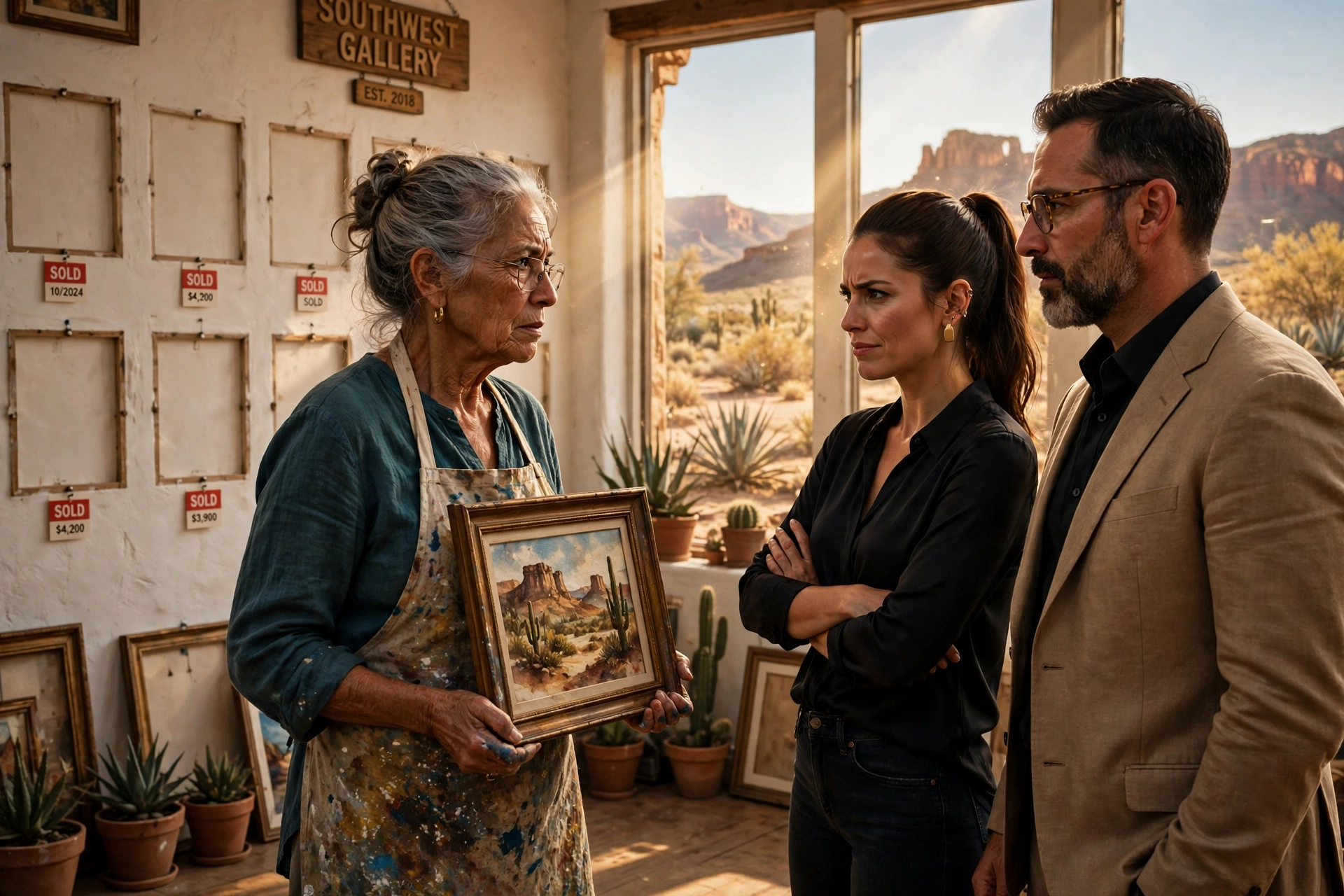
I stood in the middle of the Delacroix Gallery on Canyon Road in Santa Fe, with a glass of white wine shaking in my hand, staring at my own work. "Desert After Rain" was mine. I had painted it in my little Taos studio in the spring, after the first real rain in months, when the sage smelled sharp and clean and the sky over the mountains turned the color of bruised peaches. I had not priced it. I had not signed a consignment sheet for it. I had certainly not told anyone they could sell it. And yet there it was, hanging under bright gallery lights, with a small red dot beside it and a price card that read $48,000.
My daughter Candace was standing three feet away, laughing with a man in a linen suit, as if nothing in the world was wrong. She saw me. Her smile did not change, not even a little. She walked over, kissed the air beside my cheek, and said, "Mom, isn't it wonderful? Trent sold it in the first hour."
Trent Delacroix was the gallery owner. He was also my daughter's boyfriend, a man of forty-two with perfect hair and a voice like warm oil. He joined us and put a hand on my shoulder as if he owned that too. "June, you should be thrilled," he said. "Forty-eight thousand. That's your biggest sale ever."
"It isn't a sale if I never said yes," I said. My voice sounded strange in my own ears, too calm, too flat. "Where is the money, Trent? Where is my consignment agreement?"
Candace laughed again, a short, bright sound that made two nearby collectors turn and look. "Mom, don't make a scene," she said quietly, through her teeth. "You signed the papers months ago. You just forgot. You forget things now."
I did not forget things. I was sixty-three years old, not ninety-three. I kept every receipt, every inventory list, every letter from every collector in a locked filing cabinet in my studio in Taos. I knew exactly which paintings were in my storage room and which ones were out on loan. "Desert After Rain" was supposed to be in my storage room, wrapped in brown paper, waiting for my own fall show.
"Show me the paper," I said. "Right now."
Trent smiled the way men smile when they think a woman will give up if they wait long enough. "The office is locked for the opening, June. Come back Monday. We'll sort it out."
A collector came up then, a silver-haired woman in a turquoise necklace, and congratulated me. She said she had been outbid on my painting and asked when I would paint another one like it. I smiled because my mother raised me to be polite, even when my hands were shaking. But inside, a cold, clear thought was forming: if they sold this one without asking me, what else had they sold?
Candace leaned close and whispered, "You should be grateful. Trent and I are building your name. Without us, you'd still be selling little desert scenes at the farmers market."
I looked at my daughter, really looked at her, and I did not recognize the girl I had raised in that Taos house, the girl who used to sit on the floor of my studio with paint on her hands. The woman in front of me had my eyes and a stranger's smile.
I put my wine glass down on a white pedestal, carefully, so I would not drop it. "Monday," I said. "And I want every paper, Trent. Every single one."
He nodded, still smiling. Candace turned back to her friends. And as I walked out of that beautiful gallery into the Santa Fe evening, I pulled out my phone and counted the paintings I could still picture hanging in my storage room — and I realized, with a sick drop in my stomach, that I could not remember the last time I had actually opened that door.
---
