

## Part 6: The Missing Pages
The next morning, I went through my studio the way a detective might go through a room, slowly, touching everything, looking for what was missing instead of what was there. My painting ledger is a thick, cloth-bound book where I have recorded every painting since 1998: the title, the date I finished it, the size, the materials, and, in the margin, a note about where it went. Rosa sat beside me with a second notebook, copying titles, while I turned pages that were soft with age and smelled faintly of turpentine.
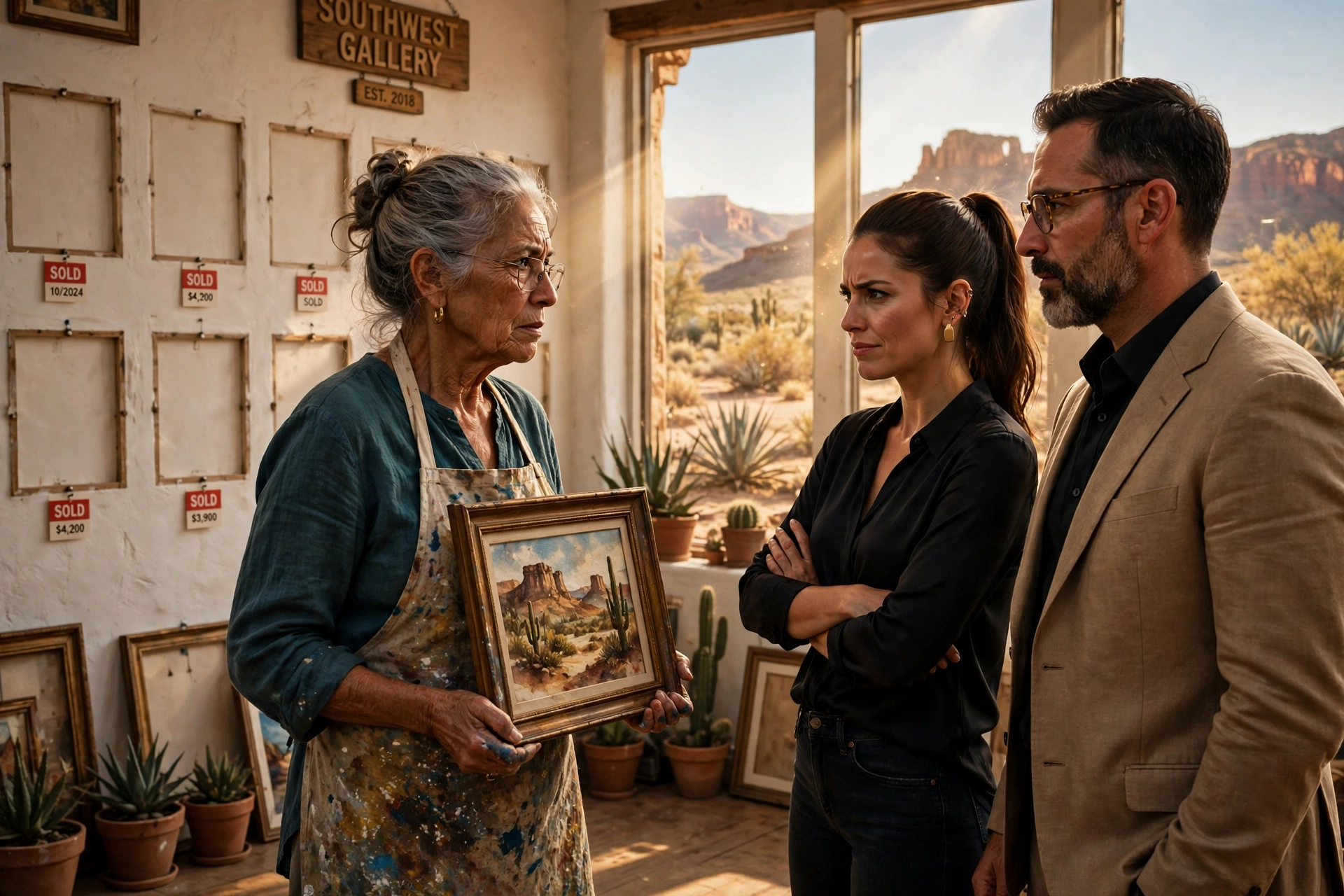
Seven pages had been torn out. Not carefully, either — the edges were ragged, as if someone had pulled them out in a hurry. The missing pages covered the years when I painted some of my best work, including the whole series of desert paintings from 2021 to 2023. Without those pages, I could not prove from my own book exactly how many paintings I had made in those years. Whoever tore them out knew what they were doing.
But they had missed something. In the back of my studio, behind a stack of old stretched canvases, there was a cardboard box I had forgotten about. Inside were the photographs I used to take of every finished painting, back when I sold at art fairs and needed pictures for my booth. I had stopped taking them when Candace told me she would "handle the photos now." The box held hundreds of prints, each one labeled on the back in my handwriting with the title and the date.
Rosa and I spent two days matching photographs to the paintings still in my studio, and to Harold's list, and to the gallery's archived sales page. By the end of the second day, we had a number that made me sit down hard on my studio stool: twenty-seven paintings missing, not twelve. The twelve on the crossed-out inventory list were only the ones someone had bothered to write down. Fifteen more were simply gone, their photographs smiling up at me from the box, their canvases somewhere else entirely.
One photograph stopped me cold. It was a painting called "Thomas in the Garden," a portrait of my late husband standing among the sunflowers he grew behind our house, his hands dirty, his face turned toward the light. I had painted it in the year after he died, crying through most of it, and I had kept it in my bedroom, not the studio, because it was too personal to sell. It was not in my bedroom anymore. I checked three times, opening every closet, looking under the bed. The wall where it had hung had a faint rectangle of cleaner paint, a ghost of where it used to be.
Candace had been in my house. She had a key. She had walked into my bedroom and taken a portrait of her own father off my wall.
I called Rosa, and she came over again, and we stood in my bedroom looking at that pale rectangle. Rosa put her arm around me and said nothing for a long time, because there was nothing to say that would make it smaller. Then she said, "June, we need a lawyer. A real one. Not a friend of a friend. Someone who handles fraud."
I nodded. I had been afraid of lawyers my whole life — afraid of the cost, afraid of the fight, afraid of what it would mean to take my own daughter to court. But I was more afraid of waking up one morning and finding my whole life's work gone, and my house gone with it, and having no proof left at all.
That night, I changed the locks on my house and my studio. The locksmith was a quiet man from Taos who did not ask questions, and when he handed me the new keys, I felt something I had not felt in weeks: a small, solid piece of ground under my feet. Then I sat down at my kitchen table and wrote a list of everything I needed: a lawyer, a handwriting expert, my tax returns, my old art fair records, and the name of every person who had ever bought a painting from me directly.
And at the bottom of the list, in capital letters, I wrote: WHO IS CANYON LIGHT?
---
