

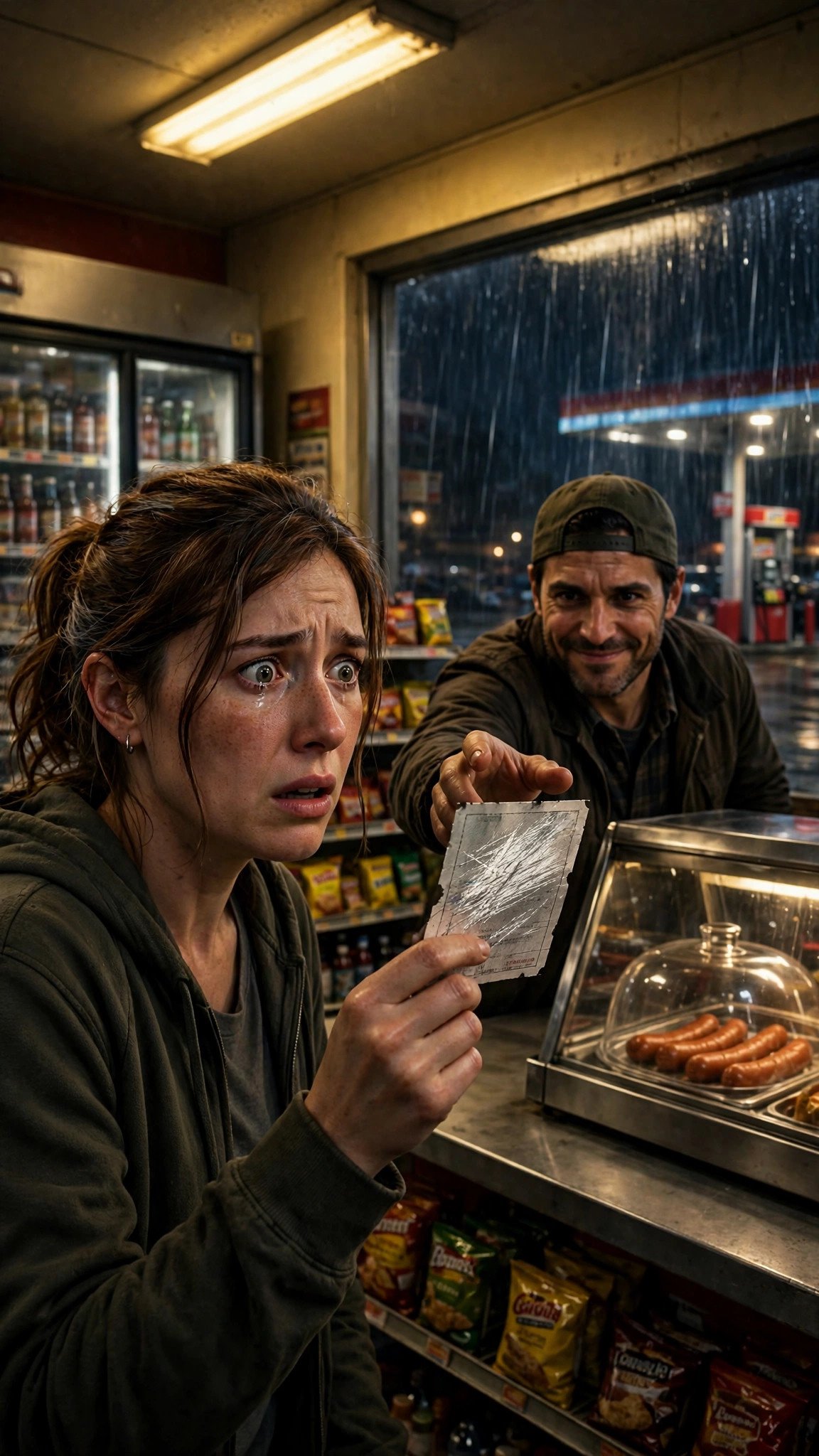
Part 7: The Lawyer Who Believed Me
Tom Ashford's office was on the third floor of a brick building in downtown Jackson, and the man himself was nothing like I expected. Sixty years old, suspenders, a voice like gravel, and eyes that had seen every scam in Mississippi.
"Sit down, Ms. Thornton," he said. "Tell me everything. Start at the gas station."
I laid it all out: the ticket, the signature, the photos, Melissa's overnight stay, the vanishing signature, the acetone cotton ball, the SUV meetings, the envelope. I handed him my phone with the timestamped photos. He studied them for a long time, zooming in on the signature.
"This is good," he said quietly. "This is very good. Most lottery theft victims have nothing. You have a timestamped, geotagged photo of the signed ticket. That's gold."
"But the lottery already paid her," I said. "Denise at the claims office said it's disbursed. One point one million, wired to Melissa's account."
Tom leaned back. "Here's what most people don't know, Emily. The lottery commission has a dispute process. When a prize claim is contested with credible evidence of fraud, they can freeze any remaining annuity payments — but she took the lump sum, so that money's gone into her accounts. What we do instead is file a civil suit for conversion and fraud, and we ask the court for a prejudgment attachment — we freeze her bank accounts before she spends it all. And we go to the police with a criminal complaint: theft, fraud, forgery. In Mississippi, lottery fraud over two hundred and fifty thousand dollars is a felony that carries serious prison time."
"How much will this cost me?" I asked.
"Nothing up front. I take a third of what we recover. But Emily — I need you to understand something. Your sister didn't do this alone. A civilian doesn't know that acetone lifts ink off a lottery ticket without destroying the security coating. Somebody coached her. And I think I know who."
He pulled out a folder. Inside was a newspaper clipping from eighteen months ago: "Elderly Woman Claims Store Clerk Swindled Her Out of $50,000 Lottery Win." The store was the Corner Mart. The clerk's name was Marcus Doyle.
"The case was dropped," Tom said. "The old woman — Gloria Delgado, eighty-one — couldn't prove it. Marcus claimed she'd sold him the ticket fair and square for fifty dollars. But I kept the file, because I never believed him. I think Marcus Doyle has been running a ticket-skimming operation for years. And I think your sister just became his biggest score."
He slid a business card across the desk. "Mississippi Lottery Commission, Investigations Division. Dana Whitfield. She's the best fraud investigator in the state. I'm calling her today. You, meanwhile, do exactly what I say: you say nothing to Melissa. Nothing to Marcus. You act like you've given up. Can you do that?"
I thought about Melissa's smug smile on her porch. I thought about the framed photocopy of MY ticket on her mantel.
"I can do that," I said.
What I didn't tell Tom — what I hadn't told anyone — was the text Melissa had sent me that morning, the one I'd been staring at for an hour: "Mom's birthday dinner Sunday. You're still coming, right? It would look really bad if you didn't."
She wanted me there. At her table. Smiling. While she played the generous millionaire.
I texted back: "Wouldn't miss it."
Because Tom was right about one thing: the best trap is the one the mark walks into herself.
