

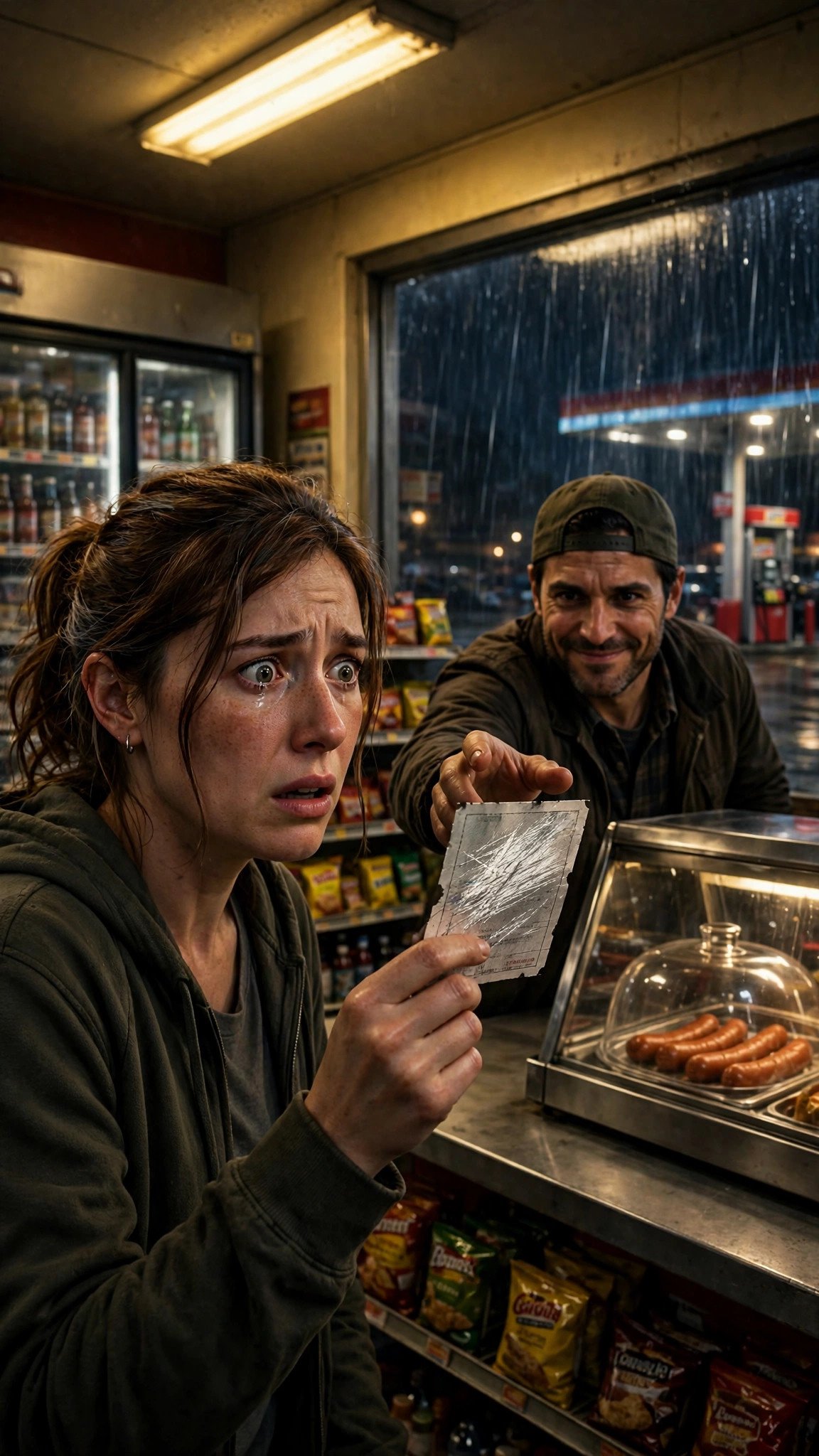
Part 6: The Clerk's Secret
The cotton ball sat in its zip-lock bag on my kitchen table like the most important object in the world. Because it was. I didn't know much about forensics, but I knew enough: nail polish remover — acetone — dissolves ballpoint pen ink. My sister hadn't just stolen my ticket. She'd chemically erased my signature, written her own over the clean paper, and walked into the lottery office like the rightful winner.
But Melissa wasn't smart enough to plan that alone. Somebody had told her how. Somebody who handled lottery tickets every single day.
Marcus.
I started watching the Corner Mart. I know how that sounds. But I had a week of night shifts at the diner and a lot of anger, and I parked across the street twice and just watched. What I saw on the second night made my stomach drop: a black SUV pulled up at 11 PM, after closing. Marcus came out the back door, got in the passenger seat, and the SUV drove off. Ten minutes later it came back, and Marcus went inside.
The SUV had dealer plates. White Tahoe. Brand new.
Melissa's new SUV.
I followed them the next night. I know — I was a waitress playing detective, and it was reckless, but I needed to understand what I was dealing with. They drove to a sports bar on the edge of town. I sat in my car across the lot and watched through the window as Melissa slid a thick envelope across the table to Marcus. He counted it. They shook hands. They laughed.
I took photos with my phone. Blurry, but clear enough: the envelope, the handshake, the two of them together.
The next day, I went to see Carla — my coworker at the diner, my best friend since high school, the only person I'd told the whole story to. She listened, then said, "Em, you need a lawyer. Not the police. A lawyer who knows lottery law. My cousin went through something like this in Jackson — there's a guy, Tom Ashford. He sues the lottery commission for a living."
"Carla, I can't afford a lawyer. I'm three weeks behind on rent."
"Tom works on contingency for fraud cases," she said. "If there's money to recover, he gets paid from the recovery. You have nothing to lose."
She was right. I called Tom Ashford's office that afternoon from the diner's back room, and his paralegal listened to my story and said, "Mr. Ashford will see you tomorrow at nine. Bring everything. Every photo, every text, everything."
That night, I got a text from an unknown number: "Stop following people, Emily. You're going to get hurt."
I showed it to Carla. She went pale. "How did they know you were following them?"
I didn't have an answer. But I had a new fear — a cold, crawling fear that Melissa and Marcus weren't just thieves.
They were watching me back.
