

PART FIVE — THE NAME ON THE BUILDING
By eleven thirty, the wedding had become something no guest would ever forget.
I did not return to the ballroom immediately.
Thomas ensured dinner continued, the band played, and staff members were paid.
The hosted alcohol remained suspended because the fraudulent credit authorization made further family-backed charges inappropriate.
Brooke’s father quietly opened his own credit card to continue basic service for guests.
It was the first wedding expense her parents actually paid.
Daniel remained upstairs.
Brooke disappeared into another suite with her mother.
Margaret contacted the trust’s outside counsel.
Samuel notified the lender.
No police arrived that night because I had not yet decided what I wanted to do.
Daniel sat across from me sometime after midnight.
His bow tie was gone.
His collar was open.
He looked like the little boy who used to sit at my kitchen table after breaking something and wait for me to tell him whether it could be repaired.
“Are you going to prosecute me?” he asked.
“I don’t know.”
He nodded.
“I deserve it.”
“Yes.”
He cried again.
I did not comfort him.
That was perhaps the hardest thing I had ever done as his mother.
“I thought I could fix everything before you found out.”
“That is what people tell themselves when they steal from someone who loves them.”
“I was scared.”
“So was I when your father died.”
He looked at me.
“I never stole your future to make my fear easier.”
He stared at his hands.
After several minutes, he whispered, “I’m sorry about the cake.”
“The cake is the least important thing that happened tonight.”
“I should have stopped her.”
“Yes.”
“I should have defended you.”
“Yes.”
“I should never have signed that affidavit.”
“No.”
He looked up.
“I meant—”
“You should never have believed my dignity was something you could borrow against.”
That silenced him.
A few minutes later, Thomas entered.
“Mrs. Carter, there is a situation downstairs.”
I nearly laughed from exhaustion.
“What now?”
“Mrs. Mercer is asking guests to remain because Brooke intends to make an announcement.”
Daniel stood.
“What announcement?”
Thomas looked uncomfortable.
“I believe she intends to say the wedding is being terminated.”
Daniel stared.
“You mean the reception?”
“I believe she means the marriage.”
They had been married for fewer than nine hours.
When we reached the ballroom, the band had stopped.
Guests clustered near the tables, confused and whispering.
Brooke stood near the cake table with her parents.
Her wedding gown was still immaculate.
Only her expression had changed.
She saw Daniel.
“You lied to me.”
A hundred conversations died instantly.
Daniel walked toward her.
“You tried to steal from my mother.”
“You told me your family owned this hotel.”
Daniel lowered his voice.
“Not here.”
“No, here is perfect.”
Brooke looked around at the ballroom.
“You let me marry you believing you had an inheritance worth tens of millions.”
Gasps moved through the guests.
Howard Mercer closed his eyes.
Diane whispered, “Brooke, stop.”
But Brooke had spent the entire day controlling the story, and she could not bear losing the final scene.
“You told me all of this would eventually be yours.”
Daniel’s voice was quiet.
“I thought part of it would be.”
“That is not the same thing.”
“No.”
Brooke looked toward me.
“And she knew you believed it.”
I almost admired the audacity.
“You believe I deceived you because my son misunderstood his inheritance?”
“You enjoyed making me look foolish.”
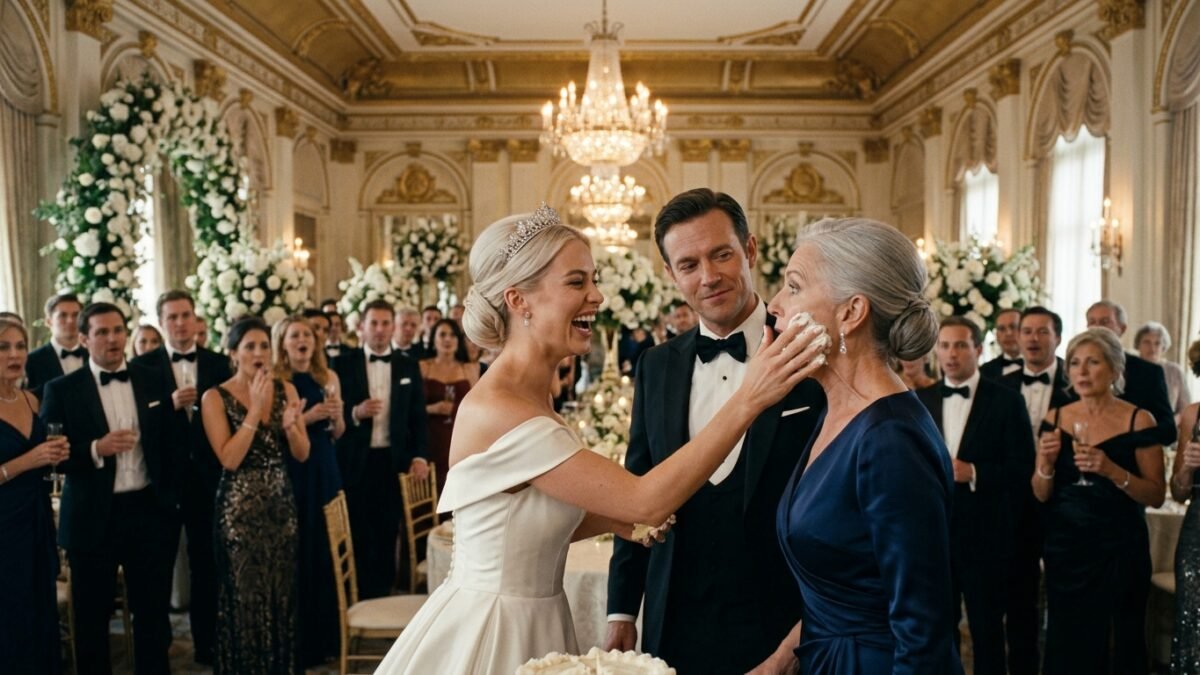
I touched the faint sticky residue still near my collar.
“You smeared cake across my face in front of one hundred and eighty people.”
Brooke faltered.
“That was different.”
“Was it?”
No one moved.
Then Thomas Harrison stepped beside me.
Brooke pointed toward him.
“And why does he act like she owns the place?”
Thomas looked at me.
I gave a small nod.
He answered carefully.
“Because Mrs. Carter is the chair and controlling trustee of Carter Hospitality Trust.”
The room became silent again.
Brooke frowned.
“What does that mean?”
Thomas continued.
“The trust owns thirty-one percent of Bellamy Property Group and holds the largest individual voting block associated with this hotel property.”
Daniel stared at me.
Apparently, even he had never understood the extent of it.
Brooke’s face drained of color.
“But thirty-one percent isn’t control.”
“Ordinarily, no.”
Margaret had joined us near the ballroom entrance.
She spoke now.
“But voting agreements with two family partnerships give Mrs. Carter effective control over major property decisions.”
A murmur rippled through the guests.
Brooke looked around the ballroom differently.
At the chandeliers.
The marble columns.
The staircase.
The room she had spent years dreaming about.
She had married Daniel partly because she believed one day it might become his.
She had humiliated the person who already controlled it.
Yet even that was not the final surprise.
Howard Mercer suddenly stepped forward.
“Evelyn, there’s something you should know.”
Brooke turned.
“Dad.”
He ignored her.
“Three months ago, Brooke asked me to invest in Briar Rose Holdings.”
Margaret’s eyes sharpened.
“How much?”
“I refused.”
Brooke shouted, “Dad!”
Howard continued.
“She told me Daniel’s mother would soon be declared financially incompetent and that Daniel would control a hotel portfolio worth more than thirty million dollars.”
Daniel looked physically ill.
Brooke’s mother covered her mouth.
I felt cold.
Howard reached inside his jacket and removed his phone.
“She sent me a business proposal.”
Brooke moved toward him.
“Give me that.”
He stepped away.
“I thought it was exaggerated salesmanship.”
Margaret took the phone.
Her eyes moved rapidly across the screen.
Then she stopped.
“What?” I asked.
Margaret looked at Brooke.
“This proposal is dated five months ago.”
Daniel stared.
Five months ago was before he had forged anything.
Before the lender crisis.
Before he had supposedly asked Brooke to help with paperwork.
Margaret scrolled.
“She had the incapacity strategy outlined before Daniel’s company reached its current cash emergency.”
Daniel whispered, “What?”
Brooke’s face finally showed fear.
Samuel leaned over Margaret’s shoulder.
“There are projections here.”
He read silently.
Then he looked at me.
“She planned to obtain control of the trust through Daniel, leverage the hotel interest, extract liquidity, and transfer proceeds to Briar Rose.”
Daniel stared at his bride.
“You planned this before I asked Mom for money.”
Brooke said nothing.
“You were waiting for my company to fail.”
Still nothing.
His voice broke.
“You married me for this.”
Brooke suddenly looked exhausted.
“I married the life you promised me.”
There are sentences that end marriages.
That one did.
Daniel removed his wedding ring.
He looked at it for several seconds.
Then he placed it on the cake table beside the knife Brooke had used earlier.
“I lied about what I had,” he said.
His voice was low but steady.
“But you married what you thought I would inherit.”
Brooke laughed bitterly.
“And now you inherit nothing.”
Daniel looked toward me.
Pain crossed his face.
“No.”
Then he looked back at Brooke.
“But for the first time tonight, I think losing it might be the only thing that saves me.”
Nobody applauded.
I was grateful for that.
Life is not a courtroom drama where every moral realization deserves cheers.
Sometimes the best a person can do is finally understand the cost after the damage is already complete.
Three months later, Daniel pleaded guilty to a reduced fraud charge after cooperating fully with investigators.
He sold his company and used nearly everything he received to repay the lender and reimburse the trust.
Brooke was charged separately after investigators found additional financial records connected to Briar Rose Holdings.
Their marriage was annulled.
I did not pay Daniel’s legal bills.
That mattered.
For the first time in his life, my son faced a consequence without his mother stepping between him and the impact.
He moved into a small apartment outside Richmond.
He found work managing accounts for a regional equipment supplier, a job far less glamorous than the company he once owned.
Every Sunday, he called me.
For the first two months, I rarely answered.
Then one rainy afternoon, I did.
“Hi, Mom.”
“Hello, Daniel.”
There was a long silence.
“I’m not calling to ask for anything.”
“I know.”
“I just wanted to hear your voice.”
I looked out my kitchen window at the dogwood tree Robert had planted thirty years earlier.
“Then talk.”
So he did.
He told me about work.
He told me about therapy.
He told me he had begun volunteering twice a month at an adult literacy program.
I did not tell him I was proud.
Not yet.
Trust, like a library, is built one shelf at a time.
A year after the wedding, Margaret and I stood inside a renovated brick building on the south side of Richmond.
Children’s books lined bright wooden shelves.
Comfortable chairs stood beneath tall windows.
A sign near the entrance read **The Robert Carter Reading Room**.
The first center funded by the trust’s new literacy initiative would open the following morning.
Daniel arrived quietly carrying two boxes of donated books.
He did not know whether I wanted him there.
I watched him place the boxes near the children’s section.
Then he approached me.
“Margaret told me this is where the trust money will eventually go.”
“Yes.”
He nodded.
“Dad would have liked this.”
“Yes.”
He looked around.
“I spent years thinking he left me money.”
I waited.
Daniel swallowed.
“I think maybe he left me a warning instead.”
For the first time in a very long while, I reached for my son’s hand.
“Your father left you a choice.”
He looked at me.
“And I made the wrong one.”
“You did.”
“Can people come back from that?”
I thought of the ballroom.
The frosting.
The forged signature.
The affidavit calling me confused.
The woman who had tried to turn my age into a weapon.
I also thought of forty-three years of birthdays, scraped knees, baseball games, college calls, Christmas mornings, and one frightened little boy sleeping beside me after his father died.
“Coming back does not mean returning to where you were,” I said.
He nodded slowly.
“Then where does it mean going?”
“Somewhere better, if you do the work.”
His eyes filled.
This time, I let him hug me.
Later that afternoon, after Daniel left, Margaret and I remained alone among the shelves.
She handed me an envelope.
“What is this?”
“Something Robert asked me to give you under very specific circumstances.”
My heart stopped.
“What circumstances?”
“If the adverse-control clause was ever triggered.”
I stared at her.
Robert had been dead seventeen years.
My hands trembled as I opened the envelope.
Inside was a single handwritten page.
I knew the handwriting immediately.
**Evelyn,**
**If Margaret is giving you this, then someone we loved mistook your kindness for permission.**
I sat down.
Tears blurred the next line.
**Do not blame yourself for loving generously.**
I covered my mouth.
Margaret looked away to give me privacy.
Then I read the final paragraph.
**There is one thing I never put in the trust documents because I wanted it to belong only to you.**
Beneath the letter was a small brass key.
Margaret smiled through her own tears.
“What does it open?” I whispered.
“A safe-deposit box Robert maintained separately.”
The next morning, we opened it.
Inside were no stock certificates.
No jewelry.
No hidden millions.
There were forty-seven handwritten letters.
One for every year Robert had hoped I might live after him.
Each envelope was numbered.
Some contained memories.
Some contained terrible jokes.
Some contained advice.
One contained instructions for the reading-room foundation.
And one contained a sentence I will remember longer than any dollar amount, hotel share, courtroom ruling, or wedding humiliation.
**If Daniel ever loses his inheritance because he tries to take what is yours, please remember that the money was never the inheritance I cared most about.**
The next line was underlined.
**You were.**
I sat inside that bank vault and cried harder than I had cried at Robert’s funeral.
For months, I had believed the wedding revealed what my family had lost.
Instead, my husband had reached across seventeen years to remind me what remained.
Brooke had wanted the Grand Bellamy.
Daniel had wanted rescue.
I had spent most of my life believing love meant giving people what they needed before they were forced to ask.
Robert, wiser than I understood, had known that sometimes love means allowing a locked door to remain locked.
The Grand Bellamy still stands in Richmond beneath its chandeliers and white stone arches.
I still attend events there occasionally.
Thomas still sends me a Christmas card every December.
And whenever I pass the ballroom where Brooke smeared wedding cake across my face, I no longer remember the laughter first.
I remember walking away.
Because at seventy-one years old, after a lifetime of rescuing everyone else, I finally learned that dignity is not something another person can take from you.
You lose it only when you surrender it.
And that night, I didn’t.
