

PART FOUR — WHAT BROOKE REALLY WANTED
The truth arrived slowly after that because lies rarely collapse all at once.
They crack.
They tilt.
Then someone removes the wrong piece, and the entire structure comes down.
Brooke had met Daniel when his company was still profitable enough to make him look far wealthier than he was.
He had taken her to dinners at the Grand Bellamy.
He had spoken casually about “our family hotel.”
He had allowed her to believe he would one day control it.
Daniel admitted this with his head lowered.
“I wanted to impress her.”
I almost laughed.
Instead, I felt tired.
“You told her you owned the Grand Bellamy?”
“Not exactly.”
Brooke gave a bitter smile.
“You said it would eventually be yours.”
Daniel looked at me.
“I thought it would.”
There it was again.
Not gratitude.
Expectation.
Margaret closed her folder.
“Beneficial inheritance is not ownership.”
Daniel nodded weakly.
Brooke had apparently learned that distinction only after becoming engaged.
By then, she had already built her imagined future around Daniel inheriting not merely money but control.
When his business began failing, she became afraid the future she had married was disappearing.
So she began creating another path.
First came the loan.
Daniel agreed to forge my signature because he believed six hundred thousand dollars would rescue his company long enough to secure a buyer.
Brooke helped prepare the documents.
Then she secretly inserted the agency agreement.
If I appeared mentally incompetent, Daniel could petition for broader temporary control.
Once Daniel controlled the trust, Brooke believed she controlled Daniel.
The forty-five thousand dollars routed to Briar Rose Holdings was not the final theft.
It was a test.
Samuel explained that the lender had been preparing a second release of two hundred and twenty thousand dollars after verification.
Briar Rose was listed as the receiving entity.
Daniel stared at Brooke.
“You were going to take it.”
“I was protecting myself.”
“From me?”
“From your failure.”
He looked as if she had slapped him.
Brooke continued, each sentence sharper than the last.
“You told me your company was worth millions.”
“It was.”
“You told me you were going to inherit the hotel.”
“I said my family had interests in it.”
“You told me I would never have to worry about money.”
Daniel stood.
“And that gave you the right to steal from my mother?”
She laughed.
“You stole from her first.”
He had no answer.
Because she was right.
Brooke had manipulated him, but Daniel had opened the door.
He had taken my signature.
He had signed an affidavit questioning my competence.
He had watched his wife humiliate me because he believed a public outburst might make the paperwork easier.
That truth hurt more than Brooke’s scheme.
I could dismiss Brooke as ambitious, cruel, even predatory.
Daniel was my son.
Daniel had known how I cared for his father through his final years.
Daniel had watched me work school book fairs after spending nights reviewing trust records I barely understood.
Daniel had called me after his first marriage ended and cried in my kitchen until sunrise.
He knew exactly who I was.
And he had been willing to describe me as mentally unstable because it might save his company.
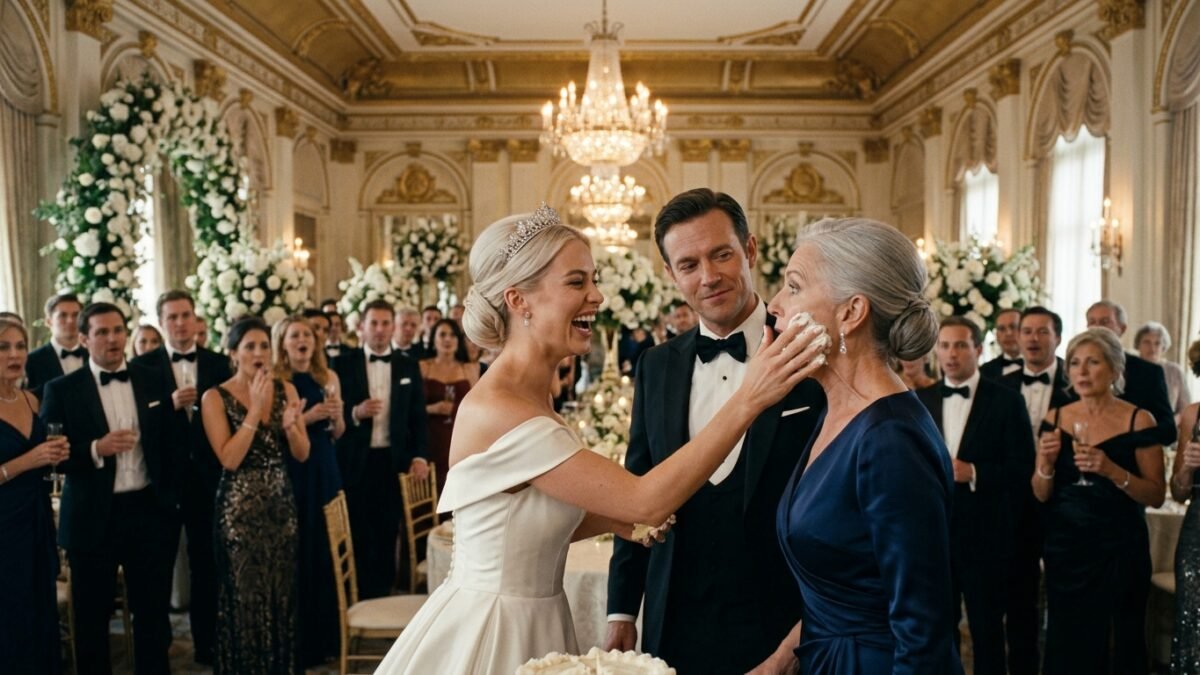
“Did you know about the cake?” I asked.
He looked at me.
“What?”
“Did you know Brooke planned to humiliate me?”
“No.”
“Did you know she wanted me to make a scene?”
He hesitated.
That hesitation answered.
“I knew she thought you might get emotional tonight.”
“Daniel.”
“She said if you caused another scene, the affidavit would make more sense.”
I closed my eyes.
There are moments when grief and anger become indistinguishable.
“You let her bait me.”
He began crying then.
Not loudly.
Daniel had always cried quietly, even as a child.
“Mom, I wasn’t thinking.”
“No.”
I opened my eyes.
“You were thinking.”
That was the saddest part.
“You simply believed I would forgive you afterward.”
He covered his face.
I turned toward Margaret.
“What happens now?”
She exchanged a glance with Samuel.
“There is one more issue.”
Brooke gave an exhausted laugh.
“Of course there is.”
Margaret ignored her.
“Evelyn, do you remember the amendment Robert made to the Carter trust in 2008?”
I searched my memory.
Robert had made several revisions after his older brother’s death.
“I remember something about protecting beneficiaries.”
Margaret nodded.
“Robert’s brother Gerald nearly lost part of the family property after persuading their mother to sign financial documents she did not understand.”
I remembered.
The scandal had nearly destroyed Robert’s relationship with his brother.
“He hated what Gerald did.”
“Yes.”
Margaret opened a thick document.
“So Robert added what we called the coercion and adverse-control clause.”
Daniel slowly lowered his hands.
“What does that mean?”
Margaret looked at him.
“It means Robert anticipated the possibility that a future beneficiary might attempt to obtain trust assets through fraud, coercion, forged authorization, or a bad-faith incapacity claim against the acting trustee.”
Daniel stared at her.
Brooke spoke first.
“So?”
Margaret’s expression remained calm.
“So the clause is self-executing.”
I suddenly remembered Robert signing those papers at our dining-room table.
I had teased him for reading every page twice.
He had looked up and said, “Money makes decent people behave strangely when they decide it already belongs to them.”
At the time, I had thought he was talking about Gerald.
Now Margaret turned one page toward Daniel.
“If a beneficiary knowingly attempts unauthorized control of the trust, that beneficiary permanently forfeits succession rights.”
Daniel stopped breathing for a moment.
“What?”
Margaret continued.
“Your affidavit and the fraudulent credit authorization triggered the clause.”
Brooke stared at Daniel.
He looked at me.
“Mom?”
I felt no triumph.
Only an immense sadness.
“Can she reverse it?” he asked Margaret.
“No.”
“I’m her son.”
“The clause specifically prevents the acting trustee from reinstating a disqualified beneficiary.”
Brooke’s voice rose.
“What happens to his share?”
Margaret looked at her.
That was when the final illusion began to die.
“It does not pass to a spouse.”
Brooke went very still.
“It passes to the alternate beneficiary designated by Robert Carter.”
“Which is?”
Margaret looked at me.
“The Carter Reading Rooms Foundation.”
I knew the name.
Robert and I had discussed creating a literacy foundation someday.
We never had enough time.
Apparently, he had planned further than I knew.
Margaret continued.
“Upon Evelyn’s death, Daniel’s former beneficial interest will now fund public reading rooms, school libraries, and literacy grants throughout Virginia.”
Daniel sat down as though his legs had failed.
Brooke looked at him with naked disbelief.
“How much?”
Nobody answered.
“How much was he supposed to inherit?”
Margaret closed the document.
“That is no longer relevant.”
But Brooke understood from the silence.
The number was large.
Very large.
Her face transformed.
For the first time all evening, she looked at Daniel not as a husband, not even as a partner, but as a failed investment.
And he saw it.
