

CHAPTER 2: THE ANTISEPTIC RADIANCE
The emergency room didn’t have the honesty of the gate. At the gate, the conflict was iron and bone; here, it was the sound of air being forced into lungs that had forgotten how to take it. Martha sat in a chair that felt like it was made of recycled industrial plastic, her fingers twisting the strap of her purse until the imitation leather began to crack.
Above her, the fluorescent lights flickered with a high-frequency buzz—a relentless, electric insect that bit at her nerves. This was the “quiet” Elias had promised her. Not the stillness of a construction site at sunset, but the vacuum of a Hoag Hospital waiting room where the only currency was patience and the only news was usually bad.
“Mrs. Thorn?”
The voice was sandpaper. Martha looked up. A doctor stood there, his coat a stark, aggressive white that hurt her eyes. He looked tired in the way men look when they’ve spent thirty years fighting the inevitable. He didn’t offer a smile. In the world of Rusted Truth, a smile was just a mask for a lack of data.
“He’s stabilized,” the doctor said, though he didn’t sit. He remained standing, a pillar of grim professionality. “But the window we missed… the delay at the gate changed the geometry of the damage. We aren’t just looking at a blockage anymore. We’re looking at oxygen deprivation to the lower chambers. We had to go in more aggressively than we liked.”
Martha’s throat felt like it was coated in the dry dust of an Irvine construction site. “He was five minutes away,” she whispered. Her voice sounded thin, a fraying wire. “The ambulance told me they were five minutes away. Why did it take twenty?”
The doctor looked at his clipboard—a different clipboard than Brenda’s, but no less a weapon of bureaucracy. “The paramedics filed an incident report. Obstruction at the Orchard Hills entrance. I’ve added it to the official medical record. You’ll need it for the insurance, and likely for the police.”
Police. The word felt heavy, like a lead pipe dropped into a quiet pool.
“I want to see him,” she said.
“He’s in the ICU. He’s under heavy sedation.” The doctor paused, his eyes softening just a fraction, a brief flash of humanity through the rust. “Go home, Mrs. Thorn. Get some clothes. Wash the smell of this place off you. You’re going to be here a long time.”
Martha didn’t go home. She couldn’t. The thought of their house—14 Crestview Court—felt like a trap. She could see it in her mind: the manicured lawn, the precisely trimmed hedges, and the shadow of the gate that now felt like a noose around their necks.
She walked to the hospital windows. Outside, the Southern California night was a wash of orange sodium haze. Somewhere out there, Brenda Vance was likely sitting in her own living room, perhaps sipping tea, satisfied that the “ledger” was balanced.
Martha pulled her phone from her purse. It felt hot in her hand. She hadn’t checked it since the ambulance had pulled away from their driveway. Her screen was a jagged mosaic of notifications. Missed calls from neighbors. Emails from the HOA automated system—one sent at 8:01 p.m., a cold, digital “Notice of Delinquency” triggered the moment the gate had finally opened.
But there was something else. A text from Eleanor Higgins at number 9.
Check the local feed. I caught her, Martha. I caught her standing there while the lights were screaming.
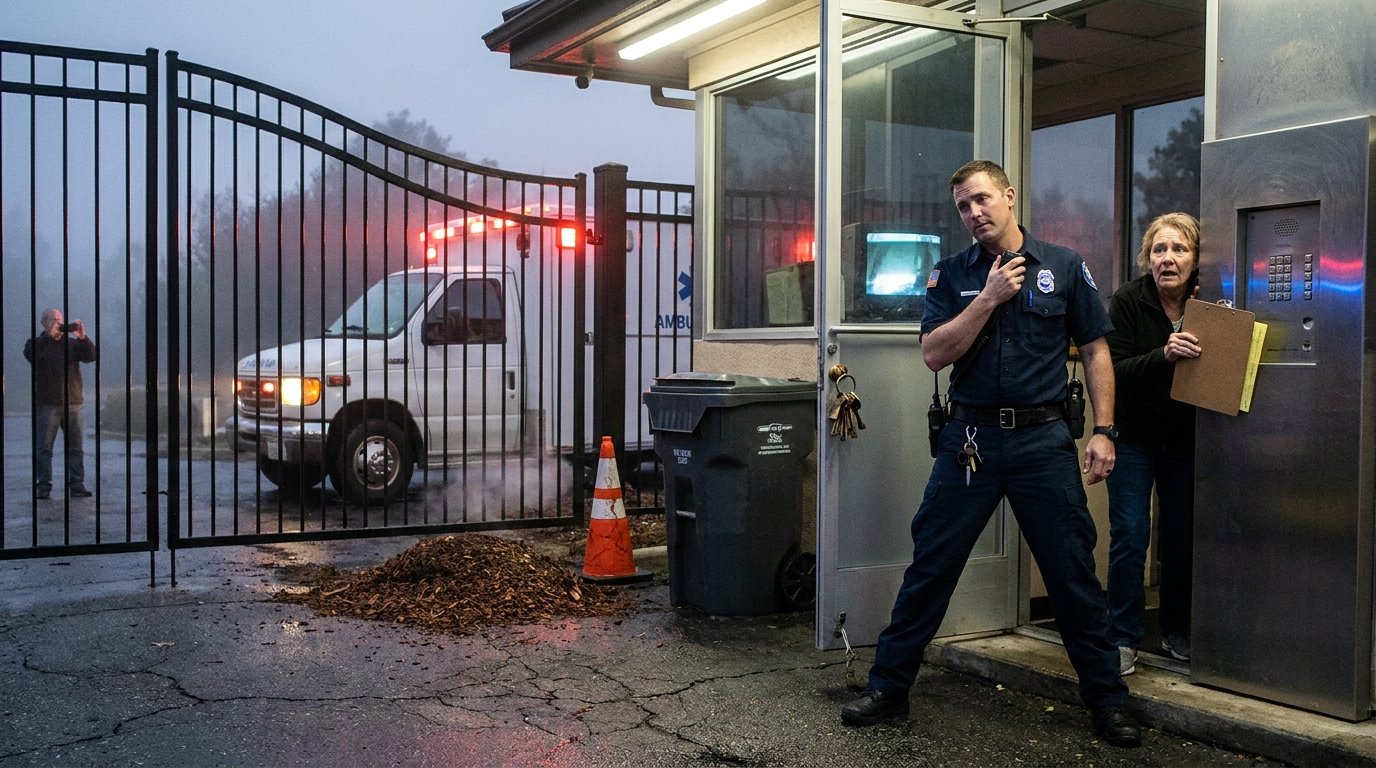
Martha clicked the link. The video was raw, handheld, and brutal. It showed the matte-black bars of the gate, the pulsing red light reflecting off Brenda’s lanyard, and the calm, terrifying indifference on Brenda’s face as she checked her watch. It wasn’t just a dispute; it was a ritual.
As Martha watched, she noticed something the internet hadn’t pointed out yet. In the video, Brenda wasn’t just holding a clipboard. Tucked under the top sheet was a sliver of yellow paper—a carbon copy of a receipt. Martha recognized the color. It was the same hue as the formal dispute Elias had filed three months ago. The one the board claimed they had never “officially” received.
The receipt was right there. Brenda was holding the very proof of Elias’s innocence while she watched his life leak out onto the asphalt.
A cold, pragmatic clarity settled over Martha. This wasn’t a mistake of the system. The system was working exactly as Brenda Vance had engineered it.
She looked back toward the ICU doors. The silent monitors hummed, a rhythmic, electronic heartbeat that replaced the one Brenda had tried to stop. Martha didn’t feel the need to cry anymore. The grief had been burned away, leaving only the scorched earth of a new, singular purpose.
She reached into her bag and found a pen. On the back of her hospital parking pass, she began to write a list. It wasn’t a list of groceries or chores. It was a list of names. The board members. The billing clerk. The security company.
The weight of the silence in the hospital was no longer a burden; it was a workspace. She realized then that Brenda’s greatest error wasn’t blocking the ambulance. It was assuming that once the gate opened, the friction would stop.
Martha looked at the yellow sliver on the screen one more time. Brenda hadn’t just misplaced the file. She was carrying it like a trophy.
The fluorescent light above Martha finally flickered out, plunging the corner of the waiting room into a gray, shadowed stillness. In the dark, the only thing Martha could see was the glowing screen of her phone, reflecting a truth that was just beginning to rust through the polished surface of Shady Canyon Estates.
