

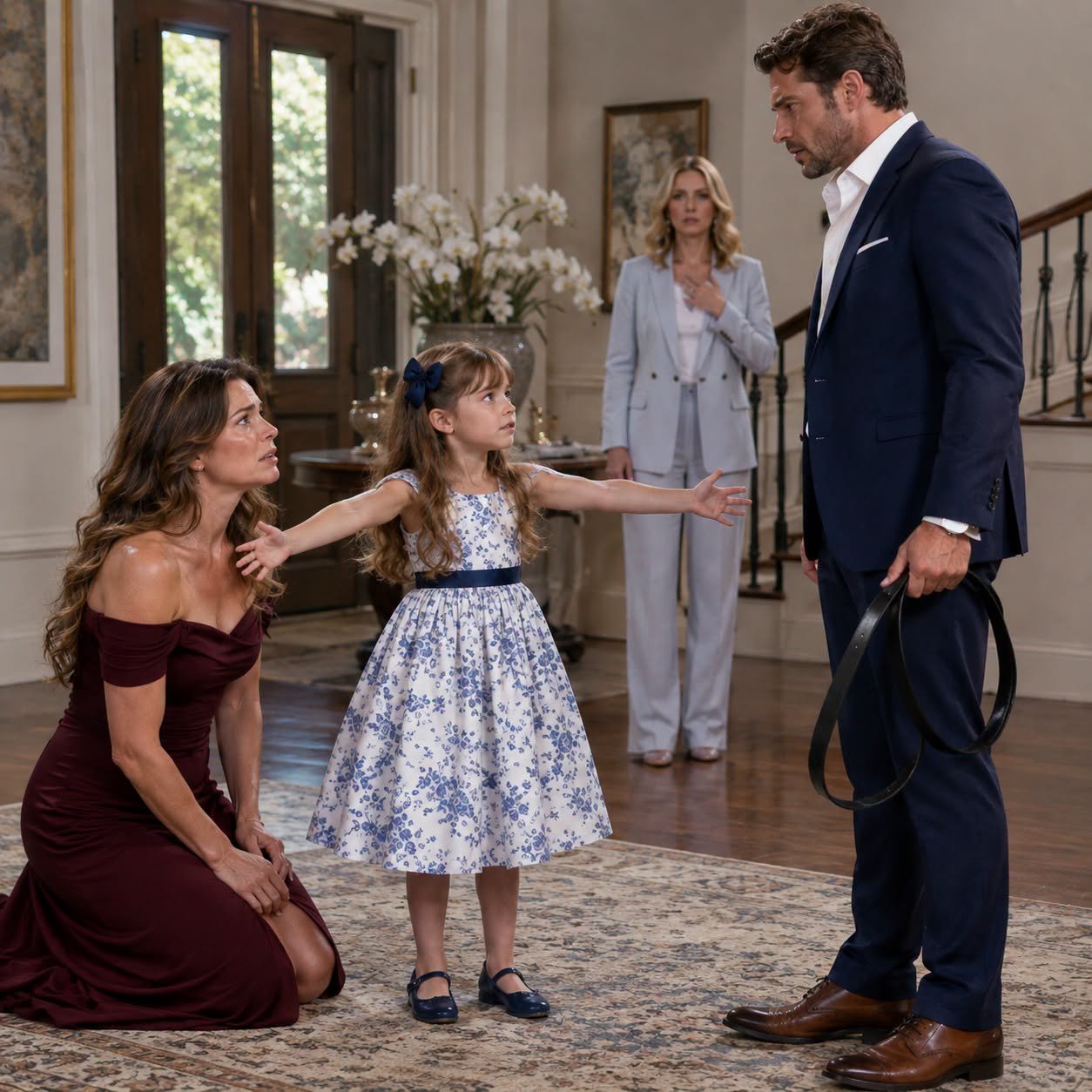
“You are keeping your own child hostage,” I said.
“I am teaching my wife how to behave,” he said.
The metal slide slammed shut with a sharp, heavy bang.
I walked back to the bottom step and sat beside my daughter. Her skin felt dry and slightly warm to the touch.
“My head hurts, Mommy,” she whispered, her voice barely carrying in the damp room.
“I know, baby. Let me see what else we have.”
I dragged my leather handbag toward me. It was the one luxury I had kept from my past, a plain black tote with brass buckles that I had carried for seven years.
I unzipped the main pocket and turned it over on the concrete floor. A comb, a half-used pack of tissues, three copper pennies, and my small travel jewelry box tumbled out.
The jewelry box was a green velvet case, no larger than a deck of cards. I unclasped the brass latch and opened it under the hanging bulb.
My mother’s small pearl earrings were there, wrapped in tissue paper. But the small velvet slot next to them was empty.
My breath went still as I stared at the empty gray indentation.
The silver Saint Christopher pendant was gone.
I searched the corners of the satin lining, my fingertips scraping the worn fabric. I had kept that pendant in this box since the night of the Aspen cabin fire six years ago. It was the only tangible thing I had left of my mother, a heavy silver disc with a small chip on the outer rim where she had dropped it on the stone steps of our Atlanta home when she was twenty.
“Is it lost?” Phoebe asked, looking down at the open box.
“I don’t know, sweetheart,” I said, though my mind was already racing back through the last few months.
I had kept the velvet box in my top dresser drawer, behind my winter socks. The drawer had no lock, but nobody in this house ever had a reason to go through my things. Or so I had believed.
“Did Aunt Gwendolyn take it?” Phoebe asked.
“Why do you say that, Phoebe?”
“She was in your bedroom last week,” Phoebe said, her voice dropping to a tiny murmur. “She was looking in the drawers when you were at the grocery store. She told me she was looking for a tissue.”
I closed the box, the brass latch clicking shut with a sound that seemed to echo off the damp stone walls.
The memory of that night six years ago came back to me, clear and sharp, stripping away the lies I had accepted for so long.
It was November, and the snow had been falling for three days in Aspen. The cabin chimney had been blocked, or the gas line had leaked, we never knew for sure, because the local fire marshal’s report had been brief and confusing.
I remembered the smell of the pine smoke first, then the heavy, sweet scent of the gas. I had been outside in the wood shed when the first explosion blew the front window out.
Russell had been inside, asleep on the sofa after drinking half a bottle of scotch.
I had run through the kitchen door, the heat melting the plastic of my boots. I found him on the floor, unconscious, his arm burned from the falling embers. I had dragged him by his collar, inch by inch, out onto the frozen grass of the driveway.
My silver Saint Christopher pendant, the one my mother had given me on my sixteenth birthday, had been around my neck when I went in. When the paramedics arrived, my collar was torn, and the chain was gone.
Two years later, when Gwendolyn came into our lives as Russell’s new business consultant, she had been wearing that exact pendant.
She had showed it to Russell over dinner one night, telling him she had bought it at an antique shop in Denver.
“It felt like a sign,” she had said, her voice high and breathless, twisting a lock of her hair around her finger. “A sign that we were meant to build this company together.”
Russell had stared at her with a look of pure, blind adoration, believing she was his guardian angel. He had always suspected someone had helped him that night, but the emergency room doctors had only seen Gwendolyn standing by his bed when he woke up. She had taken the credit, and she had used my mother’s silver to seal the lie.
I had let her keep it. I had let her believe she had won, because I was trying to protect my new life, trying to keep my family name hidden from the world. I had thought that if I lived quietly, if I stayed submissive and grateful, Russell would eventually see me for who I was.
I had been wrong.
The blood on the yellow cotton strip had dried into a stiff, dark crust, but a new spot of bright red was already forming underneath.
I stared at the door, knowing the man I loved had become my jailer.
Phoebe shifted on the hard wooden bench, her small shoulders twitching under my damp wool cardigan. The shadows in the corners of the room seemed to stretch as the single lightbulb overhead hummed, casting a yellow, sickly glare over the concrete floor.
I reached out to touch her forehead. Her skin was far too warm, the heat radiating against my fingers like a quiet warning that I could no longer ignore.
“My head hurts, Mommy,” she murmured, her eyelids fluttering but not fully opening.
She rubbed her eyes with the back of her wrist, her small fingers still clutching her stuffed rabbit. The grey fabric of the toy was stained with a dark, damp circle where she had pressed it against her temple to stop the throbbing.
“I know, sweet girl,” I said, keeping my voice level and low. “Just close your eyes. I am right here with you.”
She let out a dry, ragged sigh and drifted back into a shallow sleep. Her breathing was fast, uneven, and the makeshift bandage I had fashioned from the hem of my cotton slip was already showing a fresh spot of dark red.
“Mommy?” Phoebe whispered, her voice cracking slightly from the dry air of the basement.
“I am here, sweetie,” I said, leaning closer so she could feel my breath against her cheek.
“Can we go to Grandma’s house?” she asked, her eyes barely half-open. “The one with the big garden?”
