

My name is Hazel Voorhees. I am sixty-seven years old, and I have been a widow since 2007.
Walter died two days before our anniversary.
For three days, he had complained of a dull ache in his chest and called it indigestion. He hated hospitals. He hated doctors. More than anything, Walter hated inconveniencing people.
By the time he finally allowed me to drive him to the emergency room, he was apologizing more than he was breathing.
“I should have listened to you,” he whispered as nurses rushed toward us.
It was the last complete sentence he ever spoke.
I buried him in a blue suit he hated because I had always loved the way he looked in it.
After the funeral, I returned to our house, removed my black dress, and pulled on one of his old flannel shirts. The sleeves hung past my wrists. It still smelled faintly of cedar and his shaving soap.
On the kitchen table sat a stack of folders he had intended to review.
I made coffee.
Then I forgot to drink it.
That was how my life changed.
Not with thunder.
Not with a grand declaration.
Just a widow at a kitchen table, a cup of coffee turning cold, and a company that suddenly had no one else to run it.
Walter and I had built Voorhees Property Group together, although most people saw only his name on the first documents. We began with one strip mall in Tulsa, purchased when the bank thought we had lost our minds.
The building contained a laundromat, a nail salon, a tax preparer, and a sandwich shop that smelled permanently of pickles and fryer oil. The roof leaked. The parking lot cracked every winter. The sign buzzed like a nest of hornets after dark.
I loved every miserable inch of it.
Walter used to walk the property with a yellow legal pad beneath his arm, pretending to feel confident while both of us privately wondered whether we had destroyed our lives.
At night, after putting Theo to bed, we sat at the kitchen table and ran numbers on a calculator with half the buttons worn smooth.
We argued about interest rates.
We celebrated every signed lease.
We learned that wealth rarely arrives dressed like wealth. Sometimes it looks like a leaking roof, an unpaid invoice, and two exhausted people refusing to quit.
By the time Walter died, we owned twenty-three buildings across three states.
By the time Theo married Camille, we owned forty-one.
Now I owned fifty-three, along with minority interests in several construction firms, a regional insurance company, and the professional holding company that controlled Calder, Shaw & Henderson.
Theo never knew the full truth.
That was my decision.
I had watched money hollow out my sister Linda’s sons. They received cars at sixteen, apartments in college, and jobs invented for them whenever they failed to keep real ones.
Every mistake was softened by a check.
Every consequence was delayed.
They were not cruel boys. That almost made it worse. They were simply weak in every place ordinary life requires a person to become strong.
So when Theo was born, when the nurse placed his red face and furious little fists against my chest, I made myself a promise.
My son would grow up believing he had to earn things.
Walter agreed.
Theo grew up in a three-bedroom ranch outside Cleveland. It had beige carpet, a stubborn furnace, and a maple tree that dropped leaves faster than any human being could rake them.
He attended public school.
He rode the bus.
By seventh grade, he packed his own lunch because I told him I was his mother, not a restaurant.
At sixteen, he worked at Mickey’s Ice Cream Parlor. He came home smelling of sugar, bleach, and waffle cones.
When he wanted a car, I made him save half the down payment.
He complained for six months and eventually bought an old Honda with one door that had to be kicked from the inside before it would open.
He loved that car.
Not because it was beautiful.
Because part of it was truly his.
Later, Theo attended Ohio State on a partial scholarship and student loans. I watched him sign the loan papers with a serious expression, pretending not to be frightened.
After graduation, I paid the debt in secret.
He still believed he had paid it himself.
For years, I considered that deception an act of love.
Only much later did I realize that even well-intentioned lies cast shadows.
Theo met Camille during his second year of law school.
She was brilliant.
That was the first thing I noticed.
Not beautiful, although she was. Not polished, though even at twenty-four she possessed the composed elegance of someone who expected doors to open.
She was brilliant in a sharp, disciplined way. During our first dinner, she challenged Walter’s old theory about commercial zoning, though Walter had been dead for years and she knew his ideas only from an article Theo showed her.
She spoke quickly when excited. Her eyes brightened when discussing a case. She remembered details other people missed.
I liked her immediately.
Perhaps that was my first mistake.
Or perhaps loving someone before they disappoint you is not a mistake. Perhaps it is simply the price of being human.
Camille’s parents had struggled. Her father repaired elevators. Her mother worked as a receptionist in a dental office. Camille had attended school on scholarships, waited tables at night, and learned early that wealthy people often mistook confidence for belonging.
She wanted more than stability.
She wanted immunity from humiliation.
I understood that desire better than she knew.
For the first several years, she treated me warmly. She called every Sunday. She brought flowers on Walter’s birthday. Once, when I had the flu, she drove across town with soup and sat beside my bed correcting legal briefs.
But success changed the way she measured people.
At first, the change was small.
She began correcting my pronunciation of wine names.
Then she suggested I replace my “dated” furniture before her colleagues visited.
She stopped inviting me to dinners where important clients might attend.
When I wore the same navy dress to two Christmases, she bought me a new one without asking and said, “You need something more appropriate.”
I thanked her.
I never wore it.
Camille joined Calder, Shaw & Henderson immediately after graduation. She worked harder than anyone. She arrived before sunrise and left after midnight. She won difficult cases, brought in valuable clients, and learned how to make powerful men believe her ideas had been theirs.
She deserved advancement.
That is important.
I did not approve her partnership because she married my son. I approved it because she was exceptional at her work.
I believed responsibility might deepen her.
Instead, power only revealed what was already growing inside her.
Every Tuesday morning, I wore a gray cleaning uniform and walked through the buildings I owned.
The habit began after Walter’s death.
A property can look flawless from an executive report and be rotting beneath the paint. Managers hide complaints. Contractors inflate invoices. Executives praise themselves.
Cleaning crews know the truth.
They know which pipes leak.
They know which partners scream at assistants.
They know which bathrooms remain broken because decision-makers never use them.
So I spent Tuesday mornings beside them.
Sometimes I pushed a cart. Sometimes I emptied bins or wiped conference tables. Mostly, I listened.
At Calder, Shaw & Henderson, only three people knew who I was: the chairman, the chief financial officer, and the head of building security.
Everyone else assumed I was a senior member of the facilities staff.
I preferred it that way.
People show you their character when they believe you cannot affect their future.
One Tuesday, I saw Camille step from an elevator while I was replacing bottled water in a conference room.
Her eyes paused on my uniform.
“Hazel?”
“Good morning.”
“What are you doing?”
“Working.”
She glanced toward two associates walking behind her.
A faint flush climbed her neck.
“You clean here?”
“On Tuesdays.”
Her smile tightened.
“You never told us.”
“You never asked.”
For one moment, she seemed embarrassed.
Not for me.
By me.
She lowered her voice. “Does Theo know?”
“Not everything.”
“That is very… independent of you.”
It was an elegant sentence designed to hide an ugly thought.
She left without introducing me to the associates.
Later that morning, I found a young paralegal crying in a supply room. Her name was June Park. Camille had shouted at her over a filing error caused by a partner who had changed instructions without telling anyone.
I gave June a tissue.
“She said I don’t belong here,” June whispered.
“What do you think?”
“I think I made one mistake.”
“Then you belong wherever one mistake is survivable.”
That afternoon, Camille reversed the disciplinary note and apologized to June.
I learned about it from human resources.
That was Camille’s contradiction.
She could be cruel in the moment and ashamed in private.
She still possessed a conscience.
She simply disliked the discomfort of using it.
For a long time, I convinced myself that was enough.
When the partnership committee deadlocked over her promotion, I cast the deciding vote through the holding company.
The chairman hesitated.
“She’s talented,” he told me, “but ambitious to the point of danger.”
“So was I.”
“You were never careless with people.”
“No,” I said. “I was merely fortunate enough to have someone correct me before carelessness became habit.”
I thought partnership might become Camille’s correction.
Instead, it became her confirmation.
Three months later, Theo told me they had found their dream house.
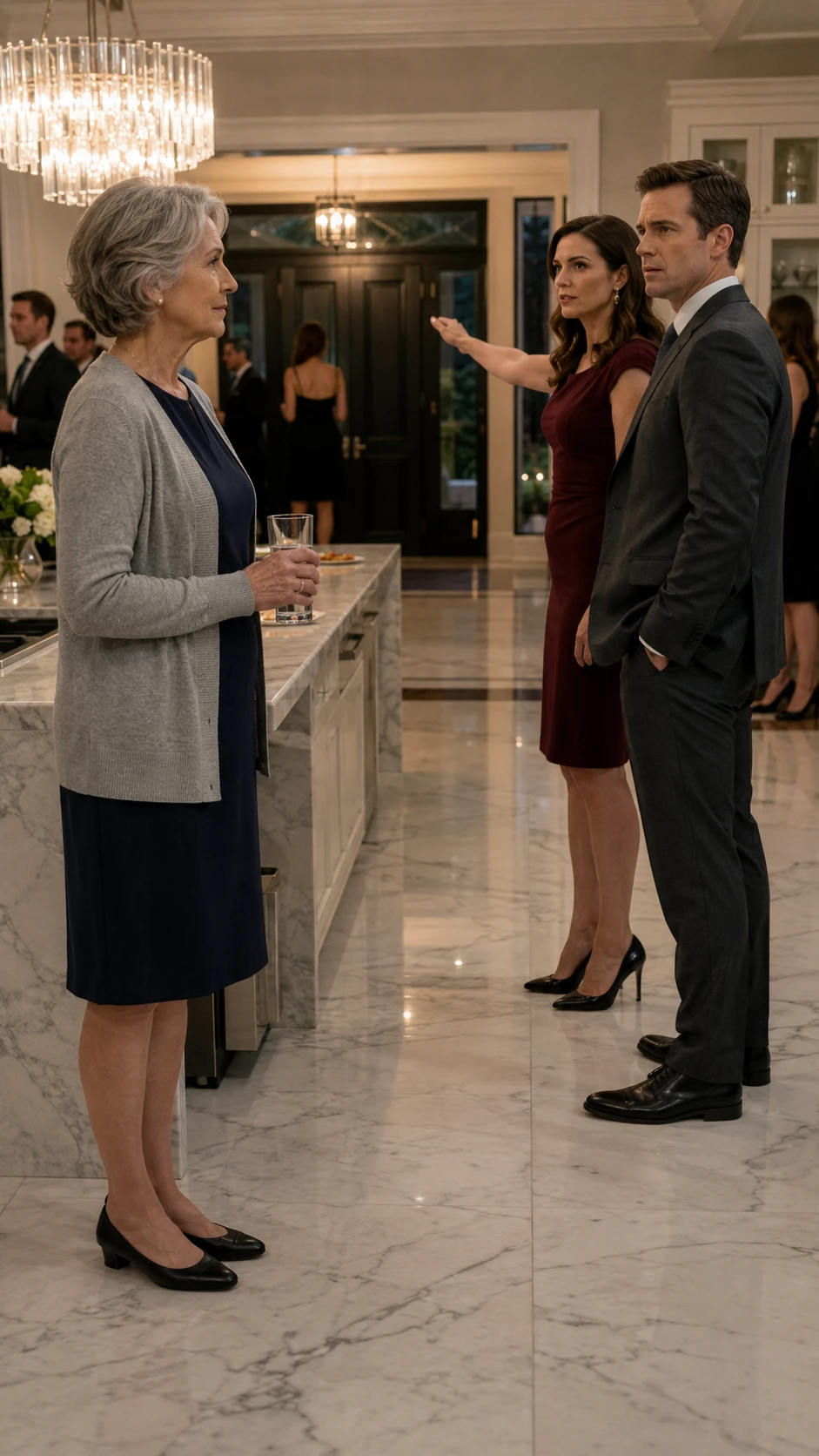
It was a sprawling modern property with limestone walls, a marble kitchen, and windows overlooking the river.
They could not afford it.
They did not know that.
Through a trust, I purchased the property, arranged favorable financing, and allowed them to believe Theo’s professional connections had secured the deal.
The deed remained tied to my holding company.
I told myself I was helping.
In reality, I was building a life around them so quietly that they never learned to recognize the hands holding it together.
