

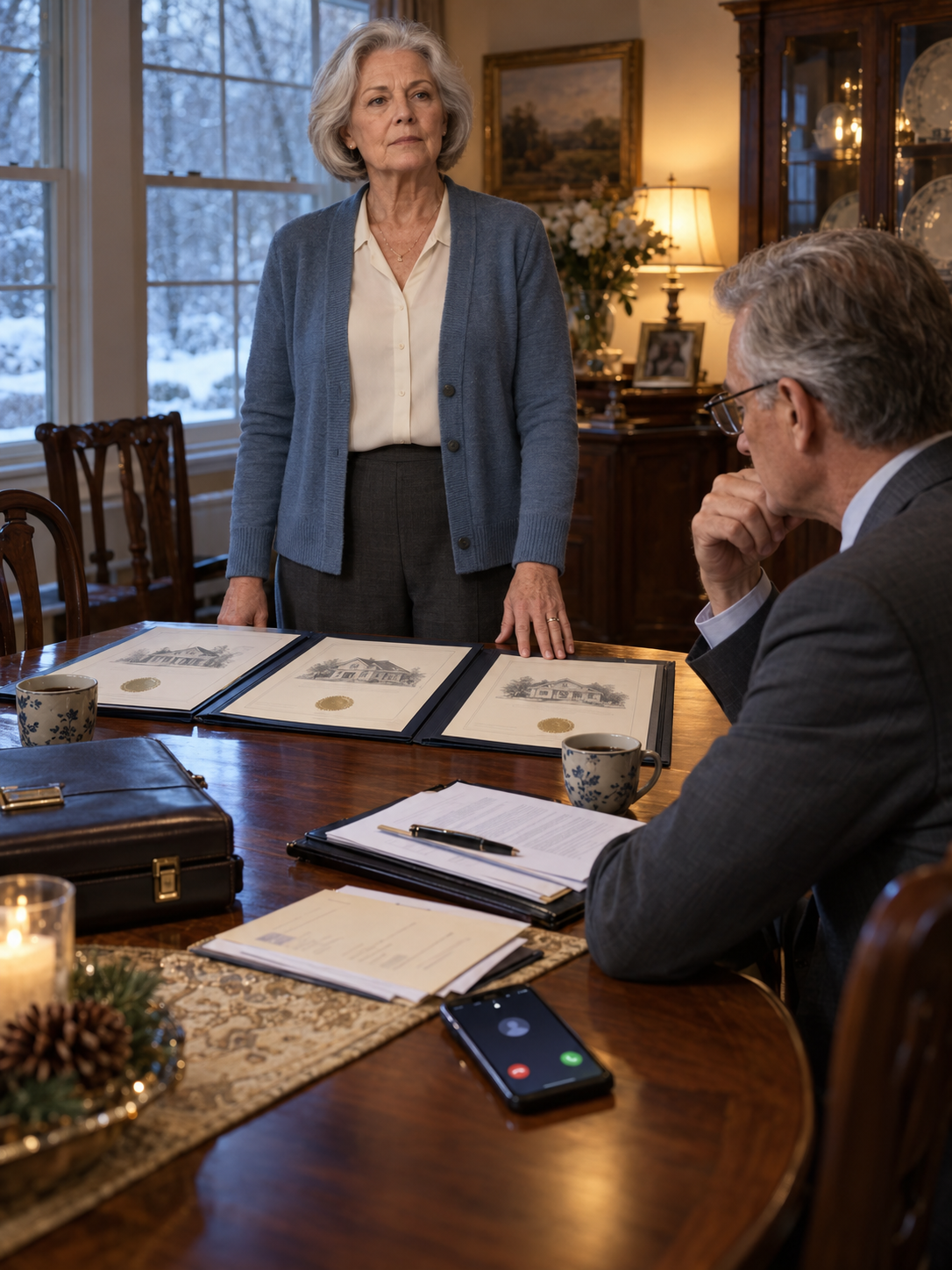
“Can Kenneth access company funds?”
“Not after this afternoon.”
That made me look up.
Mr. Abernathy opened another folder.
This one was thicker.
“Your husband’s company has concerns.”
“What kind?”
“Payments authorized by Kenneth.”
“To whom?”
“Blue Harbor Strategic Consulting.”
I had never heard that name.
“Who owns it?”
“Brenda.”
The phone began ringing again.
Neither of us moved.
“What did she consult about?”
“That remains unclear.”
“How much?”
“Over three years?”
He turned the summary around.
The number waited at the bottom.
Four hundred eighty-six thousand dollars.
I counted the digits twice.
“Thomas built that company,” I said.
“I know.”
“He missed dinners building it.”
“I know.”
“He mortgaged this house once.”
“I remember.”
“And Kenneth paid Brenda half a
million dollars?”
“Almost.”
“For what?”
“That is what the audit determines.”
The ringing stopped.
Immediately, the doorbell sounded.
I stiffened.
Mr. Abernathy checked the window.
A dark SUV blocked my driveway.
Kenneth stepped into the sleet.
Brenda emerged from the passenger side.
She wore cream cashmere.
Even from inside, I recognized it.
I had bought that coat.
Kenneth struck the doorbell repeatedly.
“Mom!”
His voice crossed the porch.
“Open the door!”
Brenda peered through the side window.
Then she saw Mr. Abernathy.
Her face changed.
Not sorrow.
Recognition.
Fear.
Mr. Abernathy closed the folders.
“You needn’t answer.”
“This is my house.”
“It is.”
“I’m done hiding inside it.”
I carried my phone toward the foyer.
Before opening anything, I activated recording.
Then I left the chain fastened.
The door opened three inches.
Cold air entered first.
Kenneth’s cheeks were red.
“What are you doing?” he demanded.
“Speaking through my own door.”
“Let us inside.”
“No.”
His mouth opened.
Behind him, Brenda crossed her arms.
“You’re being dramatic,” she said.
“Yesterday, I was unwanted.”
“We needed boundaries.”
“So do I.”
Kenneth leaned closer.
“Why is Abernathy here?”
“Business.”
“What business?”
“The kind families discuss before cutting
ties.”
Brenda stepped forward.
“You threatened our home.”
“I sent one sentence.”
“You said last dinner.”
“Yes.”
“What does that mean?”
“It means precisely what you feared.”
Kenneth shoved one hand through his
hair.
“You cannot throw us out.”
“I cannot throw you out tonight.”
He blinked.
Mr. Abernathy appeared behind me.
“But lawful notice can be served,”
he said.
Kenneth’s color drained.
Brenda recovered first.
“She doesn’t understand her own affairs.”
There it was.
Not even disguised.
Mr. Abernathy’s expression remained mild.
“She understands them exceptionally well.”
“She’s grieving,” Brenda said.
“For six years?”
“Grief can cause cognitive decline.”
I watched my son.
He stared at the porch boards.
“Look at me, Kenneth.”
Slowly, he did.
“Did you plan to declare me
incapable?”
His breath clouded between us.
“Who told you?”
Not denial.
Never denial.
Behind him, Brenda whispered his name.
He ignored her.
“It wasn’t like that.”
“How was it?”
“You’ve made questionable decisions.”
“Name one.”
“The properties.”
“What about them?”
“You keep control over everything.”
“I own everything.”
“That’s exactly the problem.”
The words landed softly.
Their meaning did not.
Kenneth gripped the porch railing.
“We live there,” he said.
“We’ve improved that house.”
“With my money.”
“We raised children there.”
“Without rent.”
“We considered it ours.”
“I know.”
For the first time, my voice cracked.
“That was my mistake.”
Brenda stepped nearer.
“We deserve security.”
“You received security.”
“No,” she snapped. “We received permission.”
The truth hung between us.
Permission had insulted her.
Ownership was the only acceptable gift.
I felt something inside me settle.
Not vengeance.
Finality.
“Blue Harbor,” I said.
Brenda stopped breathing.
Kenneth turned toward her.
Mr. Abernathy watched them both.
“I don’t know what you mean,”
Brenda said.
“Four hundred eighty-six thousand dollars.”
“That was legitimate consulting income.”
“What services did you provide?”
“Brand strategy.”
“For an industrial pump manufacturer?”
She looked toward Kenneth.
He closed his eyes.
I understood before either spoke.
He knew.
Perhaps not everything.
Enough.
“You signed those payments,” I said.
“Mom, listen.”
“I am listening.”
“The company needed modernization.”
“Show me the work.”
“There are reports.”
“Then the auditors will find them.”
Brenda’s composure shattered.
“You called auditors?”
“The board did.”
Kenneth struck the railing once.
“You went to the board?”
“I own the controlling shares.”
“You don’t understand daily operations.”
“Perhaps.”
I lifted my phone slightly.
“But I understand theft.”
Brenda’s eyes fixed upon the screen.
“Are you recording us?”
“Yes.”
“You need our consent.”
Mr. Abernathy answered calmly.
“Not on her open front porch.”
She stepped backward.
Her heel slipped on ice.
Kenneth caught her elbow automatically.
That small motion wounded me strangely.
He could steady her.
He had watched me fall alone.
“Leave,” I said.
“Mom—”
“Proper notices arrive tomorrow.”
“You’re destroying our family.”
“No.”
I looked directly at him.
“I’m refusing to be destroyed by it.”
Brenda pointed through the doorway.
“This proves you’re unstable.”
“No,” Mr. Abernathy said.
“It proves she has counsel.”
The doorbell camera caught everything.
Brenda noticed it too late.
She seized Kenneth’s arm.
“We’re leaving.”
He remained still.
His face looked suddenly younger.
For one second, I saw him
at eight years old.
Scraped knees.
Missing front tooth.
Thomas’s baseball cap swallowing his head.
Then he looked away.
They returned to their SUV.
I closed the door carefully.
My hands shook afterward.
Mr. Abernathy secured the deadbolt.
“You did well,” he said.
“I wanted him to choose me.”
“I know.”
“He never even apologized.”
“He came to stop consequences.”
That distinction broke something open.
I reached for Thomas’s empty chair.
Instead, my knees struck the floor.
Mr. Abernathy did not offer platitudes.
He brought a glass of water.
Then he sat nearby.
I cried without elegance.
Not only for yesterday.
I cried for every dinner invitation
that never came.
Every photograph cropped carefully.
Every call answered with impatience.
Every holiday I financed invisibly.
Every excuse I manufactured for them.
Most of all, I cried because
love had not protected us.
My love had fed their entitlement.
My silence had helped it grow.
When the tears finally eased,
the soup smell reached the dining room.
“My neighbor,” I said.
“What?”
“I forgot her soup.”
Mr. Abernathy checked the clock.
“Then we should deliver it.”
The ordinary task saved me.
I reheated the pot.
I poured broth into glass containers.
Mrs. Alvarez lived two doors away.
Pneumonia had kept her bedridden.
Her granddaughter opened the door.
“You remembered,” Sofia said.
The relief in her eyes hurt.
“Of course.”
Inside, Mrs. Alvarez called weakly.
“Is that my favorite troublemaker?”
I carried the soup upstairs.
Her room smelled of eucalyptus.
A humidifier whispered beside her bed.
“You look terrible,” she said.
“So do you.”
“Good. Sit down.”
I sat.
She tasted one spoonful.
Her shoulders relaxed.
“Thomas’s recipe?”
“Mine.”
“He only chopped vegetables.”
“He claimed supervisory authority.”
She smiled.
Then her gaze sharpened.
“What happened?”
I could have lied.
Instead, I told her.
Not every legal detail.
Only the unbearable shape.
Mrs. Alvarez listened without interruption.
When I finished, she covered my
hand with hers.
“My daughter stopped speaking to me
once.”
“You never told me.”
“It lasted fourteen months.”
“How did you survive?”
“I stopped confusing access with love.”
The humidifier breathed between us.
“Did you forgive her?”
“Eventually.”
“Was everything normal afterward?”
“No.”
Her answer came gently.
“We built something new.”
“Was it smaller?”
“Much.”
“Was it enough?”
“It was honest.”
I carried those words home.
By midnight, ninety-nine missed calls filled
my screen.
Kenneth accounted for fifty-eight.
Brenda had called seventeen times.
Gertrude called eleven.
Mason called eight.
The remaining five came from relatives
who rarely remembered my birthday.
There were messages too.
Some pleaded.
Some accused.
Some mentioned lawyers.
None asked whether I was safe.
None apologized.
At 12:14, Mason sent three words.
I am sorry.
I read them repeatedly.
Then I turned off my phone.
The next morning arrived startlingly bright.
Ice covered every branch.
Sunlight filled the kitchen.
At nine, a process server delivered
notices to all three homes.
The agreements would terminate lawfully.
Nobody would become homeless overnight.
Kenneth received sixty days.
Mason received sixty days.
Gertrude received sixty days.
Each could contest the notice.
Each would receive due process.
My car guarantee was formally reviewed.
Automatic payments ended immediately.
The company board suspended Kenneth.
The financial audit expanded.
Mr. Abernathy filed sworn evidence opposing
the incapacity petition.
By noon, relatives discovered consequences had
names.
Mortgage.
Insurance.
Tuition.
Utilities.
Club dues.
Phone plans.
All those invisible expenses connected backward.
Every path ended at me.
My phone remained off.
I spent the afternoon cleaning.
Not frantically.
Deliberately.
I gathered framed photographs from hallways.
I did not destroy them.
I placed them inside labeled boxes.
Kenneth’s first school picture.
Mason asleep against Thomas’s chest.
Gertrude laughing beside our mother.
Brenda holding newborn Lily.
History remained history.
Pain could not erase tenderness.
Tenderness could not erase betrayal.
Both belonged in the boxes.
Near dusk, someone knocked softly.
Not the bell.
Three careful taps.
Through the window, I saw Mason.
He stood alone.
A cardboard file box filled his arms.
I opened the inner door.
The chain remained fastened.
“I deserved that,” he said.
“What do you want?”
“To give you this.”
“What is it?”
“Everything I should have brought sooner.”
He lowered the box onto the porch.
Inside were printed emails.
Meeting notes.
Bank summaries.
A small digital recorder.
My stomach tightened.
“How long did you know?”
“About the petition?”
“Yes.”
“Three weeks.”
The answer struck cleanly.
No excuses softened it.
“Three weeks,” I repeated.
“I kept telling myself Kenneth wouldn’t
file.”
“You watched them isolate me.”
“Yes.”
“You stayed silent.”
“Yes.”
“Why?”
His eyes filled.
“Because they promised me the company.”
Snowmelt dripped from the gutter.
Somewhere nearby, a dog barked.
Mason wiped his face roughly.
“Kenneth said you were holding everyone
back.”
“And you believed him?”
“I wanted to.”
“Why?”
“Because wanting made it easier.”
He nodded toward the box.
“Brenda planned everything.”
“No.”
My response startled him.
“Brenda did not make you silent.”
His shoulders folded.
“No.”
“Kenneth did not make Gertrude lie.”
“No.”
“And I did not make you greedy.”
“No.”
Each admission seemed to lower him.
Finally, he sat on the porch step.
“I hated myself yesterday,” he whispered.
“Yesterday?”
His eyes closed.
“Longer.”
I studied my younger son.
Mason had always avoided conflict.
As a child, he hid beneath tables
during arguments.
Thomas called him our peacemaker.
Perhaps we praised cowardice mistakenly.
“What is on the recorder?”
“The family meeting from last Sunday.”
“Why did you record it?”
“I started getting scared.”
“For me?”
“For myself.”
At least that was honest.
“Kenneth discussed transferring the deeds.”
“How?”
