

The conference room smelled faintly of old coffee and furniture polish.
Colonel Sloan closed the door behind us.
The sound of the ceremony outside became a muffled hum.
For several seconds, nobody sat.
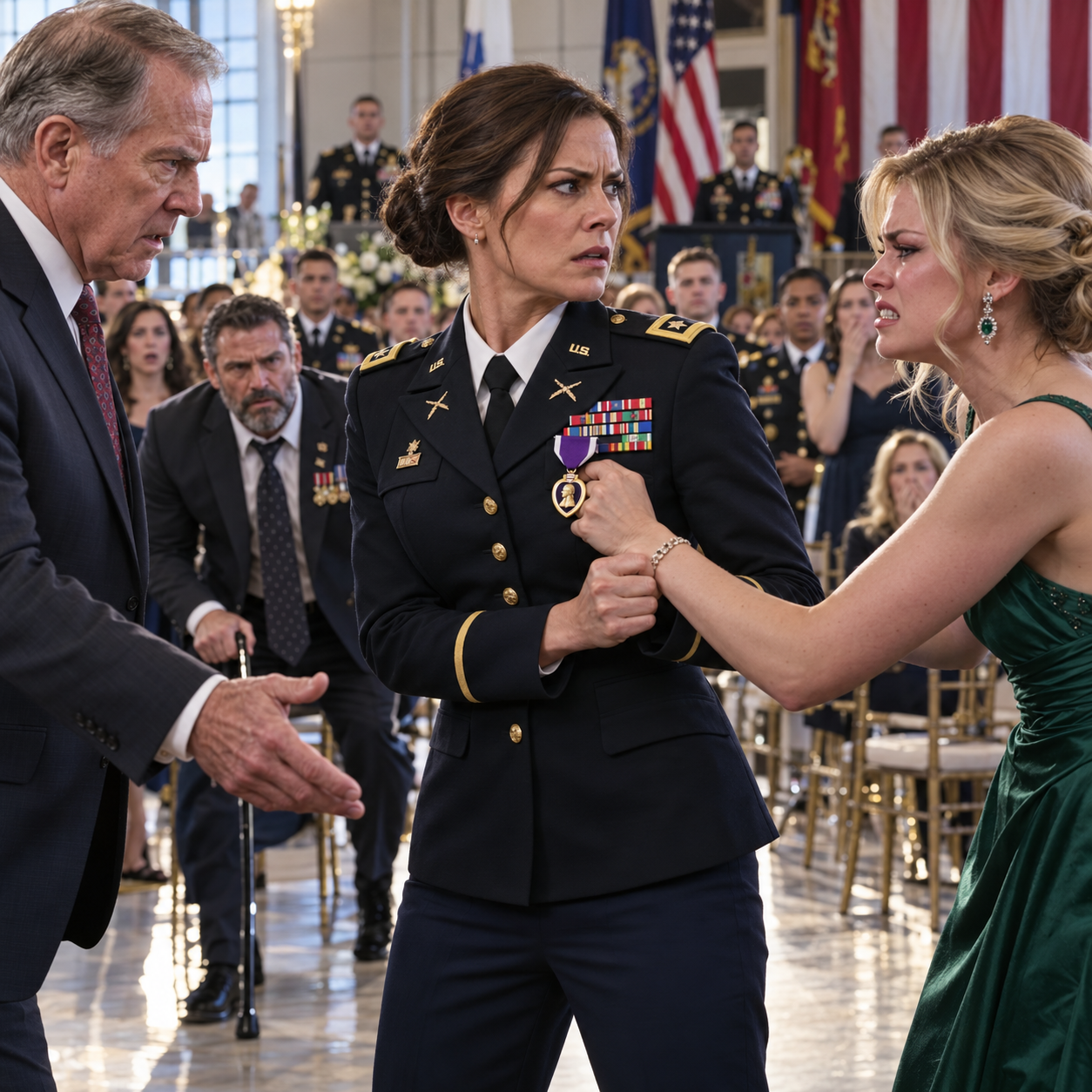
Brooke stood nearest the door, rubbing the wrist I had grabbed.
Dad faced Daniel.
Daniel faced Dad.
I stood between all of them feeling as though I had entered a conversation that had begun years before I arrived.
Colonel Sloan finally spoke.
“We are not doing this in the middle of the armory.”
Daniel nodded.
“Yes, ma’am.”
“You’re staying?”
He looked at me.
“If Major Caldwell wants me to.”
I almost laughed at the formality.
“Sit down before your leg makes the decision for you.”
A familiar expression crossed his face.
“There she is.”
My throat tightened.
For one second, he wasn’t a middle-aged veteran leaning on a cane.
We were thirty-something again.
Dusty.
Exhausted.
Arguing over bad coffee in a place thousands of miles from home.
Then he lowered himself into the chair.
The effort cost him more than he wanted me to see.
He extended his damaged leg.
The black cane rested beside him.
I looked at it too long.
He noticed.
“Don’t.”
“Don’t what?”
“Do the thing.”
“What thing?”
“The guilt thing.”
“I’m not.”
“You are.”
Brooke looked between us.
“What happened to him?”
I didn’t answer.
Daniel did.
“Same thing that happened to your sister.”
“Not the same,” I said.
“No.”
His tone was matter-of-fact.
“Mine was worse.”
Dad flinched.
Daniel saw that too.
I sat opposite him.
“You should have told me you were coming.”
“I knew you’d tell me not to.”
“That has never stopped you before.”
“There she is again.”
I almost smiled.
Then I looked at the envelope.
“What’s inside?”
The humor left his face.
“Records.”
“What kind?”
“Maintenance reports. Test results. Internal emails. Contract correspondence.”
Dad finally moved.
“Avery, before you read any of that, you need context.”
I turned toward him.
“Then give me context.”
He sat slowly.
For the first time that evening, he looked old.
Not silver-haired.
Old.
There is a difference.
My father had spent most of his adult life as a corporate attorney.
When I was a child, I understood his job in fragments.
He wore expensive suits.
He left before breakfast.
He came home after dark carrying legal pads.
He used words such as discovery, liability, exposure, settlement, arbitration.
When I asked what he did, he once said, “I keep companies from making expensive mistakes.”
Mom, standing behind him, had raised an eyebrow.
“Sometimes after they’ve already made them.”
Dad had not found that funny.
As I grew older, I learned that his clients included manufacturers, shipping companies, technology firms, and government contractors.
He liked difficult cases.
He liked rooms full of people who needed him to know something they did not.
He liked control.
And from the moment teachers began telling him his older daughter was good at arguing, he imagined I would become him.
“You think clearly,” he used to tell me.
“You don’t panic.”
“You notice details.”
“You could do something meaningful with that.”
Apparently leading soldiers had never fully qualified.
Daniel placed the envelope on the table.
“Tell her who Bellwether Defense was.”
Dad closed his eyes.
The name struck something in my memory.
Bellwether.
I had heard it.
News?
A briefing?
A vehicle manual?
Then it clicked.
“They built vehicle armor.”
Daniel nodded.
“Among other things.”
I looked at Dad.
He stared at the table.
“They were one of my clients,” he said.
Brooke’s head snapped around.
“What?”
Her shock looked real.
That mattered.
Later, I would replay the moment and understand how much she had known and how much she hadn’t.
At the time, all I saw was my sister staring at our father as though a wall had shifted behind him.
“When?” I asked.
Dad hesitated.
Daniel answered.
“Before the attack. During the attack. After the attack.”
My pulse began to pound behind my ears.
I looked at Daniel.
“What did Bellwether make for us?”
“Underbody reinforcement kits.”
I knew exactly what he meant.
Months before the convoy attack, our vehicles received new armor packages.
Ugly things.
Heavy.
Bolted beneath the floor.
One soldier had joked that somebody had attached a bathtub under an armored truck.
We laughed.
Soldiers laugh at equipment constantly.
It is one of the ways you pretend machinery cannot kill you.
Nobody joked after the attack.
Daniel leaned forward.
“The device that hit us was powerful.”
My mouth had gone dry.
“I know.”
“Nobody is saying the blast itself wasn’t severe. But three engineers later concluded the floor reinforcement should not have separated the way it did.”
“The investigation said the blast exceeded the design threshold.”
“The Army report said that.”
I stared at him.
“What other report?”
Daniel looked at Dad.
My father spoke.
“Bellwether conducted internal testing.”
“When?”
Silence.
I could hear someone speaking through the microphone outside.
Applause followed.
Another medal.
Another family.
Another normal evening occurring several walls away.
“When, Dad?”
“Nine months earlier.”
My fingers became cold.
Daniel pushed the envelope toward me.
I did not want to open it.
That is something people rarely admit.
We imagine truth as a moral good people naturally reach for.
Sometimes truth sits twelve inches away inside a manila envelope, and every instinct tells you to leave it closed.
Because before you open it, your life still has the shape you recognize.
Afterward, it might not.
I opened it.
The first page was a photocopied engineering memorandum.
Date.
Project number.
Bellwether logo.
I scanned the heading.
REINFORCEMENT SYSTEM — IMPULSE LOAD DURABILITY TEST.
My eyes dropped.
WELD SEPARATION UNDER REPEATED IMPULSE LOAD.
I read it twice.
Another line.
POTENTIAL CATASTROPHIC FLOOR-PLATE FAILURE.
My hand shook.
I pressed it flat against the table.
Nobody commented.
Daniel would have noticed.
He always noticed.
I turned the page.
Photographs.
A steel plate peeled from a test assembly.
Welds fractured.
Measurements.
Diagrams.
My mind superimposed something else over the images.
Sand.
Smoke.
A vehicle floor bent upward.
Daniel trapped.
Blood.
I swallowed.
“These are authentic?”
Daniel nodded.
“Copies of authenticated records.”
I looked at Dad.
“You’ve seen these?”
He didn’t answer immediately.
“Robert,” Colonel Sloan said.
Not loudly.
He looked at me.
“Yes.”
“When?”
“Before your attack.”
Brooke whispered, “Oh my God.”
I kept turning pages.
I found emails.
One had a sentence highlighted in yellow.
Disclosure prior to contract renewal may create substantial procurement risk.
Below it was a legal recommendation.
My eyes went first to the signature.
Before I read the text.
ROBERT M. CALDWELL.
I stared at the name.
There are moments when the mind performs small acts of desperation.
Mine tried to make him somebody else.
Another Robert Caldwell.
Another attorney.
Another father.
The letters remained where they were.
I looked up.
“What did you recommend?”
His face had gone gray.
“Avery—”
“What did you recommend?”
“I advised the company regarding its disclosure obligations.”
Daniel laughed once.
A short, bitter sound.
“Say it in English.”
Dad glared at him.
“Stay out of this.”
Daniel leaned back.
“I was blown halfway through an armored floor. I’m already in it.”
Dad’s jaw tightened.
I held up the page.
“Say it.”
My father took a breath.
“I advised Bellwether that the test results did not necessarily trigger mandatory disclosure because the prototype test conditions differed from the field specifications delivered under contract.”
The words sounded rehearsed.
Maybe they were.
Lawyers build sentences like walls.
I looked at him.
“Did you believe that?”
“Avery, the technical question was complicated.”
“Did you believe it?”
“The test setup—”
“Dad.”
My voice dropped.
“Did you believe what you wrote?”
His eyes lowered.
“No.”
Brooke made a small sound beside me.
I stared at him.
Not blinking.
Not breathing properly.
Something inside me was becoming frighteningly calm.
“You knew the system might fail.”
“I knew engineers had concerns.”
“You knew.”
“There is a difference between a concern and an established defect.”
“You helped them keep it from the Army.”
“I advised them within the law as it existed.”
Daniel’s face hardened.
“That sentence has buried more people than any shovel.”
Dad turned on him.
“You think I don’t know what happened to you?”
Daniel’s eyes changed.
“No.”
His hand closed around the handle of the black cane.
“I think you know exactly what happened to me.”
He tapped the cane once against the floor.
“Every morning I put this foot down, I know.”
I looked at Dad.
“How long after the attack did you know it was my convoy?”
His eyes closed.
“That’s not—”
“How long?”
“Avery.”
“How long?”
“Nine days.”
The ventilation system clicked overhead.
That tiny sound became enormous.
Nine days.
Nine days after the attack, I had been in a hospital in Germany.
I remembered Dad standing beside the window.
Mom sat in the chair with her shoes off, sleeping beneath a borrowed blanket.
Dad looked destroyed.
I woke in the middle of the night.
My mouth was dry.
My shoulder felt enormous and distant.
He came toward me.
“Hey.”
His voice was soft.
I had whispered one thing.
“Daniel might lose his leg.”
Dad went pale.
I thought it was horror.
Of course it was horror.
His daughter’s friend had nearly died.
Anyone would react.
Except now that memory changed.
The pallor.
The way he turned toward the window.
The way he told me, “You don’t need to talk about any of this right now.”
Nine days.
“You knew when you came to Germany.”
He rubbed his face.
“I knew enough.”
“You stood beside my hospital bed knowing Bellwether had tested that armor.”
“I had suspicions that the failure might be related.”
“You knew.”
“Avery—”
“You knew.”
He stopped trying to change the word.
“Yes.”
My throat tightened.
Dad had always said he could not bear combat stories.
The first Thanksgiving after I came home, I tried to tell them about the convoy.
Not the worst part.
Just enough.
Brooke went quiet.
Mom held my hand.
Dad stood up and said he needed more wine.
Later he told me, “I don’t think I can listen to details like that.”
At Christmas, Brooke asked me to change the subject when I mentioned Daniel’s rehabilitation because Lily was nearby.
I learned quickly.
My family wanted the sanitized version.
Attack.
Injury.
Recovery.
I gave them what they could tolerate.
Fourteen years of silence.
I believed I was protecting them.
All those years, the silence had protected him.
“You let me think you couldn’t bear hearing about the war.”
His eyes filled.
“I couldn’t.”
“For a different reason.”
He looked away.
I stood.
My chair rolled backward.
Daniel started to move.
“I’m fine.”
“No, you’re not.”
I looked at him.
“No. I’m really not.”
He stopped.
I faced Dad.
“After the attack, what did you do?”
“I pushed Bellwether to correct the reinforcement system.”
“Publicly?”
“No.”
“Did you notify procurement?”
“I couldn’t simply disclose privileged material.”
“So you fixed it quietly.”
“I tried.”
“So nobody would know.”
His expression tightened.
“You are reducing an incredibly complicated situation to—”
“To what? My bleeding?”
“Avery.”
“To Daniel’s leg?”
His face crumpled.
“That’s unfair.”
I slapped the signed memorandum onto the table.
“Is it?”
Brooke flinched.
I rarely raised my voice.
That was something people misunderstood about military authority.
Good leaders did not scream constantly.
If you were screaming, you had usually lost something.
Control.
Time.
Trust.
That night, I was losing all three.
“You spent my entire adult life dismissing my career,” I said. “You called it a phase. You called it stubbornness. You called this ceremony elaborate. Ten minutes ago, you called the Purple Heart ‘the injury.’”
He opened his mouth.
I kept going.
“Was that because you thought the Army was a mistake?”
“Avery—”
“Or because every time you looked at my uniform you saw your own signature?”
He could not answer.
That was answer enough.
I sat again.
My legs felt unreliable.
Daniel pulled another document from the envelope.
“There’s more.”
I laughed.
I didn’t mean to.
It came out sharp.
“How much more?”
His eyes moved toward Brooke.
Something in my sister’s posture changed.
She had been crying quietly.
Now she became still.
Daniel watched her.
“Enough that somebody in this family has been lying to you much more recently than fourteen years ago.”
Brooke raised her head.
“What does that mean?”
Daniel said nothing.
Her face changed.
Fear.
The same fear I had glimpsed in the armory.
I looked at her.
“Brooke?”
“Why is he looking at me?”
Daniel placed a printed email on the table.
The sender’s name had been blacked out.
The domain hadn’t.
I knew it immediately.
A marketing agency in downtown Seattle.
Brooke’s employer.
The subject line read:
BELLWETHER REBRAND — HISTORICAL RISK REVIEW.
My stomach dropped.
I looked at my sister.
“You worked for them?”
Her arms folded.
Defensive.
Immediate.
“My agency did.”
“When?”
She hesitated.
Daniel answered.
“Eighteen months ago.”
She turned on him.
“Stop answering for me.”
“Then start answering.”
I looked at Brooke.
And suddenly her hand on my medal no longer looked like thoughtlessness.
It looked like panic.
“What did you know?”
She stared at me.
“Not what you think.”
“I don’t know what I think anymore.”
“Avery—”
“What did you know?”
Dad rose.
“Brooke, you do not need to discuss confidential client material.”
I turned toward him.
“Sit down.”
He stared at me.
So did Brooke.
I had never spoken to my father that way.
Not when he refused to speak to me for days after I enlisted.
Not when he asked at thirty whether I intended to keep wasting my education.
Not after Mom’s funeral when he told me she would have wanted me to “finally come home.”
Something had changed.
Maybe it was simply that I had realized obedience had never bought honesty from him.
“Sit down.”
He did.
Brooke stared at the tabletop.
“Our agency was hired after Bellwether merged with another company.”
“What did they want?”
“Rebranding. New corporate name. New public positioning. Messaging. Reputation management.”
“And the email?”
“There was a historical risk archive.”
“What does that mean?”
She hesitated.
“Anything that could become a public-relations problem.”
Daniel said, “Old lawsuits.”
Brooke nodded.
“Procurement disputes. Worker complaints. Safety issues. News coverage.”
“Including the armor?”
“Yes.”
“Including our convoy?”
Her eyes met mine.
“Yes.”
The air left my chest slowly.
“When did you find out?”
“Eleven months ago.”
Eleven months.
I thought of all the conversations since then.
Christmas.
Her birthday.
Two dinners.
A phone call where she spent twenty minutes complaining about Dad’s refusal to replace his old furnace.
She had known.
“You knew for almost a year.”
Tears rose in her eyes.
“Yes.”
“You knew Bellwether had hidden those tests.”
“Yes.”
“You knew Dad represented them.”
“Yes.”
“You knew Daniel had been hurt.”
“Yes.”
“Then tonight you stood in front of me and called my Purple Heart performative.”
She closed her eyes.
“I know.”
“You grabbed it.”
“I know.”
“You tried to pull it off.”
“I know.”
My voice cracked.
“Why?”
Her eyes snapped open.
“Because I panicked!”
The words exploded from her.
Silence.
Brooke stood.
Her hands trembled.
“I saw the photographer.”
She pointed toward the wall as if she could see through it.
“I saw those people near the back.”
“What people?”
She looked at Dad.
He looked away.
“Dad told me there might be federal investigators here.”
I stared at him.
“What?”
Brooke kept going.
“He said if reporters or investigators started asking questions about your old Purple Heart while you were receiving another medal, they might connect your name to the Bellwether case.”
“So you decided to make the medal disappear?”
“I wasn’t thinking.”
“No.”
I shook my head.
“You were thinking. You just weren’t thinking about me.”
Her face crumpled.
“That’s true.”
The admission hit differently than another excuse would have.
She sank into her chair.
“I saw it on your uniform and I saw everything at once. Dad. Bellwether. The files. The possibility that someone would ask what happened to you.”
I laughed bitterly.
“So you protected him.”
“No.”
Dad looked toward her.
Brooke met his eyes.
“No.”
Then she reached into her purse.
She removed a small silver flash drive.
My father stood.
“Brooke.”
She didn’t look at him.
“Don’t.”
“What is that?”
“You know what it is.”
“Brooke.”
She placed the drive on the table.
“I copied the archive.”
Dad went white.
“You did what?”
“Every relevant file.”
“You violated your contract.”
“Yes.”
“You violated confidentiality obligations.”
“Yes.”
“You could lose your career.”
“I know.”
She turned toward me.
“I sent copies to Daniel.”
I stared at her.
Daniel nodded.
“Anonymous package. Six months ago.”
My mind could not make the pieces fit fast enough.
“You?”
Brooke nodded.
“You were his source?”
“Yes.”
“Why didn’t you tell me?”
“Because Dad knew someone had copied the files.”
She looked at him.
“He was trying to find out who.”
My father’s voice was low.
“You had no idea what you were doing.”
Brooke swung toward him.
“I knew exactly what I was doing after I read your emails.”
She pulled a folded page from her purse.
“I read the email where Bellwether’s president asked if Avery’s injury created a conflict for you.”
Dad froze.
Brooke unfolded it.
My heartbeat became painful.
“What did he say?”
Brooke swallowed.
Then read.
“My daughter’s military service is a personal matter and does not affect my professional judgment.”
The sentence entered me slowly.
Client.
Career.
Daughter.
Separate compartments.
My father had spent his whole life organizing the world into clean categories.
Work.
Family.
Law.
Emotion.
Duty.
Personal matters.
Professional judgment.
The problem was that I had bled across the line.
Brooke’s voice shook.
“That was when I sent everything to Daniel.”
Dad looked at her as though she were a stranger.
“You destroyed this family.”
My sister stared back.
For most of her life, Brooke had folded under my father’s anger.
Not that night.
She pointed at the memorandum with his signature.
“No.”
Her voice was quiet.
“You did that before I ever opened the file.”
For the first time in years, my sister and I stood on the same side of something.
I wasn’t ready to forgive her hand on my medal.
But for the first time that night, I understood that Brooke had not simply inherited Dad’s silence.
She had begun trying to break it.
Daniel slid another paper toward me.
“There is a federal investigation.”
I read the heading.
DEPARTMENT OF JUSTICE — CIVIL FRAUD SECTION.
“Bellwether?”
“And others.”
I looked at Dad.
“What does ‘others’ mean?”
Daniel answered.
“Executives. Law firms. Anyone involved in withholding material test information from procurement officials.”
Dad gave a tired laugh.
“You make it sound like a conspiracy.”
Daniel’s eyes hardened.
“Call it whatever helps you sleep.”
Colonel Sloan finally spoke.
“Does the Army know about this?”
“Inspector General does.”
I stared at the papers.
This was no longer a private betrayal.
“How many failures?”
Daniel’s expression changed.
That was when fear entered me again.
“How many?”
“Avery—”
“How many documented failures after the initial Bellwether tests?”
“Seven.”
My fingers went numb.
“How many casualties?”
He did not answer.
“Daniel.”
His eyes met mine.
“Eleven killed.”
I stopped breathing.
“Twenty-three wounded.”
Eleven.
Twenty-three.
Numbers are efficient.
That is why institutions use them.
Eleven killed.
Twenty-three wounded.
But I had spent too much time in uniform to hear numbers without seeing doors.
Families.
Commanders removing their hats before entering living rooms.
Hospital ceilings.
Rehabilitation wards.
Empty chairs.
Daniel’s cane.
My shoulder.
I looked at Dad.
“Did you know about the later incidents?”
“Not all.”
“How many?”
He closed his eyes.
“Four.”
Brooke started crying.
I couldn’t.
I had gone somewhere beyond tears.
Then Daniel spoke.
“There’s one more thing.”
I looked at him.
“What?”
“The files Brooke sent me weren’t the first copies.”
Brooke lifted her head.
Daniel turned toward her.
She looked suddenly terrified again.
I stared between them.
“What does that mean?”
Brooke swallowed.
“The copies I found weren’t the first set.”
“Whose were they?”
She looked at our father.
Then back at me.
“Mom’s.”
That word broke through every defense I still had.
Our mother had been dead for three years.
And somehow, impossibly, she had just entered the room.
