

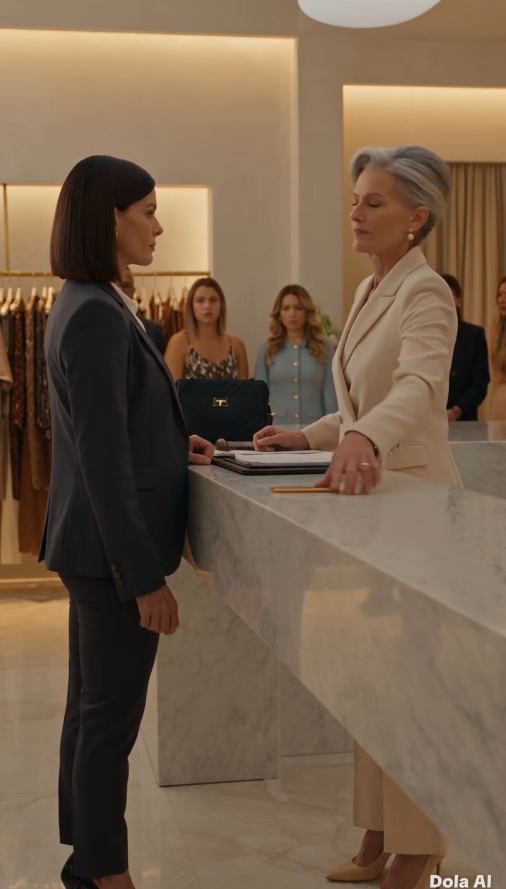
“Natalie,” he said quietly, “you should have left this alone.”
I felt something inside me go still.
All the uncertainty disappeared.
All the doubt.
Martin had just answered the only question that mattered.
I stood.
“You knew Richard kept copies.”
“I suspected.”
“And you knew Blake would come after my office.”
“I knew Blake was desperate.”
“You let him.”
Martin looked toward Sofia.
“This meeting is privileged.”
Daniel laughed.
“No, it isn’t.”
One of Martin’s attorneys stepped forward.
Daniel held up a hand.
“Try me.”
The attorney stopped.
I looked at Martin.
“Did you create the transactions under my credentials?”
“No.”
“Did someone working for you?”
He said nothing.
“That’s not a difficult question.”
Martin sighed.
“You think companies are built by people who have the luxury of making clean decisions.”
“No. I think that’s what people say when they’re about to explain stealing.”
His expression hardened.
“You have no idea what was at stake.”
“Billions?”
“Twenty-three thousand employees.”
That stopped me.
Martin stepped into the room.
“The acquisition secures this company for decades. International expansion. Manufacturing guarantees. Pension protections. Employee retention commitments.”
“And twenty-three thousand employees need you to secretly buy minority shares?”
“They need stability.”
“Using company money?”
“Vendor rebates are legally complicated.”
Daniel said, “That may be my favorite sentence of the week.”
Martin ignored him.
I asked, “Why Blake?”
Martin looked tired.
“Because Blake approached me.”
Everything inside me tightened.
“When?”
“Eleven months ago.”
Vivian had told me Martin approached Blake.
One of them was lying.
Martin continued.
“He knew about Richard’s investigation. He offered to sell his inherited stake.”
“Then why didn’t you buy it?”
“Because he wanted nearly three times market value.”
That sounded exactly like Blake.
“So you made another arrangement.”
“He suggested he could help consolidate vendor relationships.”
“Through fake credits.”
“He called them efficiencies.”
“You paid him through Northstar.”
Martin said nothing.
“Two hundred forty thousand dollars.”
Still nothing.
Then I understood something.
“You didn’t recruit Blake to commit fraud.”
“No.”
“He recruited himself.”
Martin’s eyes met mine.
“That distinction matters.”
“Not as much as you think.”
Martin glanced toward the documents.
“Blake began manipulating credits beyond anything we discussed. When compliance noticed, I realized the situation had become dangerous.”
“So you decided to frame me.”
“I decided to let the audit determine responsibility.”
“Using my credentials.”
“I did not authorize anyone to use your credentials.”
“Who had access?”
He looked at Sofia.
“Sofia?”
She said, “Executive finance could generate delegated authorization tokens.”
“Who runs executive finance?” I asked.
Martin’s silence answered.
His longtime chief financial officer.
