

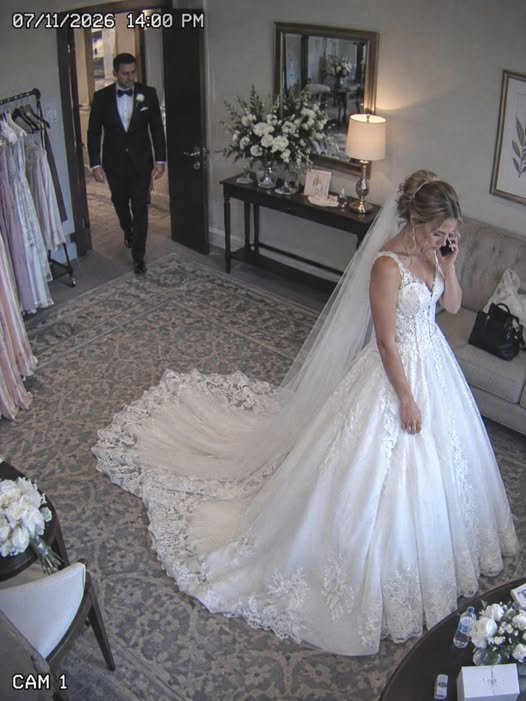
He looked at her.
“Hello, Linda.”
There was no warmth in it. Not cruelty either. Just the particular neutrality of a long history that had not ended well.
Tristan leaned close to me. “Jess, who is he?”
“This is Richard.”
He looked at me with the expression of a man who has been given an answer that contains no information.
Richard extended his hand to Tristan with a slight smile. “You must be Tristan.”
“Yes, sir.”
“Congratulations on your wedding.”
“Thank you.” Tristan glanced between us. “I’m still trying to understand what’s happening.”
“I imagine you are.”
Linda stepped forward, her composure returning in that specific way of people who have spent decades using composure as a defense. “What are you doing here?”
Richard looked around at the garden he owned. “I live here.”
Her face changed.
That was the moment I knew she understood. Not just that this was his estate. But what it meant that I had known about him, that I had found him, that I had called him this morning.
That I had known for months what she had spent years trying to bury.
Tristan turned to his mother.
“Grandfather?”
Linda’s mouth tightened. “This is not the time.”
“I think it’s exactly the time,” Richard said.
There is a version of how I found Richard that involves research and luck and the particular instinct of someone who notices when a story has pieces missing.
It started eight months before the wedding, in Linda’s living room.
Tristan and I had been sorting through an old box of family photographs — the kind of task that wedding planning tends to generate, digging up pictures for slideshows and memory tables, assembling the visual history of two families becoming one. Linda had left us to it, gone into the kitchen to make tea, and I had been moving through the box carefully when I found a photograph that stopped me.
Tristan as a toddler, maybe two years old. Sitting on the shoulders of a man I had never seen — a tall man with dark hair and an open, uncomplicated smile, holding Tristan’s small legs to steady him, looking up at him with the particular delight of someone who is completely happy in that exact moment.
On the back, in pencil: Tristan and Grandpa Richard, summer 1996.
I turned the photograph over. Looked at Tristan in it. Looked at the man.
When Linda came back with the tea, I asked her about it.
She took the photograph from my hand in a single smooth motion, the way you remove something from a child who has picked up something breakable.
“He isn’t part of our lives.”
That was all.
Later, I asked Tristan. He knew almost nothing. A family argument when he was very young. A grandfather he barely remembered. His mother had always changed the subject, and he had eventually stopped asking.
I should have left it there.
But something about the photograph stayed with me — the man’s face, the child on his shoulders, the simple happiness of it. And something about Linda’s reaction stayed with me too. Not the brevity of it. The speed. The way she had moved before I could ask a follow-up question.
Pride looks different from grief. I have learned to tell them apart.
It took weeks to find him. I am not going to pretend it was simple. But people leave traces, and Richard had not gone far, and eventually I found a phone number.
He answered cautiously, the way people answer calls from unknown numbers when they have learned that unknown sometimes means unwanted.
I said Tristan’s name.
His voice changed immediately.
“Is he all right?”
That question. The speed of it. The shape of it. It told me more than Linda had given me in all the months I had known her.
We talked for almost an hour. Richard told me about the argument — Linda had accused him of interfering in her marriage, and he had said things he regretted, and then the silence had calcified the way silences do when nobody moves first and both sides are too proud. He had tried to reach back. Letters returned. Calls unanswered. And eventually, he told me, she had stopped telling Tristan that he was reaching out at all.
“He thinks you hate him,” I said.
A long pause.
“I never hated him.”
We talked several more times after that, carefully, neither of us certain what we were building toward. And at some point, Richard said something I had filed away as probably a joke.
“If anything goes wrong with the wedding, call me.”
I had laughed. “What could possibly go wrong?”
He smiled — I could hear it. “I’ve known my daughter longer than you have.”
Standing now in the garden, Tristan looked at me with an expression I had never seen on him before. Not anger. Something more complicated than that.
“You knew,” he said.
“Not for very long.”
“How long?”
“Six months.”
He absorbed this.
“Why didn’t you tell me?”
It was the right question, and I had thought about the answer many times.
“Because I didn’t know if it would go anywhere,” I said. “And because I thought you deserved to make your own decision about him. Not have it made for you.” I paused. “The way your mother made her decisions about him for you.”
He looked at Richard.
Richard looked back at him steadily, without pressure, without the particular desperation of someone who needs something from the reunion in order to feel whole.
“I thought you hated me,” Tristan said quietly.
“I never hated you.”
“She said you didn’t want contact.”
