

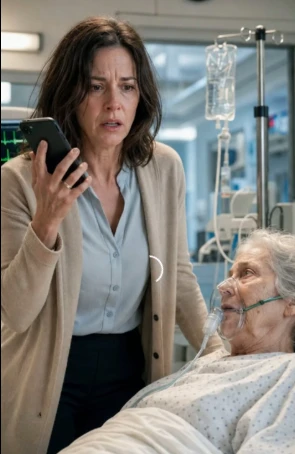
The key remained in my pocket.
I signed forms until my name stopped looking familiar.
Evelyn Carter Whitmore.
Twenty years of marriage had attached Mark’s name to mine so firmly that I could barely remember the woman who had existed before it.
When I finally left the hospital, rain had begun to fall.
I sat in my car in the parking garage and stared at Mark’s contact on my phone.
Thirty one outgoing calls.
No response.
There was one new message from him.
It had arrived three minutes after his mother was pronounced dead.
Running into an important dinner. Stop calling unless it is serious.
For several seconds, I could not breathe.
Then I took a screenshot.
I forwarded it to an email account Mark did not know existed, an account Margaret had helped me create six months earlier.
At the time, she had insisted that every woman should have a place where no husband, son, or lawyer could reach her private thoughts.
I had teased her for being dramatic.
Now I understood.
I typed a reply to Mark.
Your mother died at 2:47 this afternoon.
His answer arrived almost instantly.
What?
Then another.
What happened?
Then another.
Why did you not reach me?
That was the first moment I understood exactly how dangerous he was.
He had ignored thirty one calls, but within seconds of learning that Margaret was dead, he began writing the version of events he intended to tell everyone else.
I did not answer.
Instead, I drove home through the rain with Margaret’s last command echoing inside my mind.
Destroy him.
The Whitmore estate sat behind iron gates on fourteen acres outside Philadelphia. It was not the house where Mark and I had begun our marriage. We had moved there after his father died, supposedly because Margaret could no longer live alone.
Mark called it his family home.
Margaret always called it my prison.
The building was beautiful from a distance. Gray stone walls. Tall windows. Ivy spreading around carved columns. Inside, however, it felt colder every year.
Mark preferred rooms no one used and furniture no one touched. He wanted everything polished, arranged, and silent. Even our marriage had eventually become another decorative object he displayed to visitors.
The loyal wife.
The devoted son.
The brilliant businessman.
None of it was real.
When I entered the house, Margaret’s wheelchair remained beside the window in the sitting room. Her book lay open on the table. A cup of tea had gone cold beside it.
I placed my hand on the back of her chair.
Only that morning, she had been sitting there watching cardinals gather in the garden.
She had seemed restless.
“Promise me something,” she had said.
I had been sorting her medication into a small plastic organizer.
“What is it?”
“If something happens to me, do not let Mark handle the arrangements.”
I had looked up.
“Nothing is going to happen.”
“Evelyn.”
Her voice had carried a sharpness that the strokes had not managed to erase.
“Promise me.”
I promised.
At the time, I thought she feared Mark would choose an ugly coffin or bury her beside the husband she had despised.
Now I wondered whether she had known death was coming.
I carried the bag of her belongings upstairs and placed it on her bed.
The room smelled faintly of lavender and the hand cream she used every night. Her closet doors were open. Dresses hung in careful rows. Every jacket had a tiny section of its inner lining altered by hand.
Margaret had sewn the key into whichever garment she wore.
I took it from my pocket and examined it under the lamp.
It was smaller than a house key and older than anything else in the room. A number had been engraved into the metal.
I searched her desk first.
No lock.
I opened drawers, examined jewelry boxes, and ran my hands beneath shelves. I looked inside her wardrobe, beneath the bed, behind paintings, and under the loose floorboard she had once used to hide chocolate from her physical therapist.
Nothing.
At midnight, headlights swept across the front windows.
For one foolish second, I thought Mark had returned.
Instead, a black sedan stopped beneath the portico.
A tall man stepped out carrying a leather briefcase.
I recognized him as Arthur Bell, Margaret’s attorney.
He was seventy, silver haired, and always dressed as though he expected to be photographed entering a courthouse. During Margaret’s illness, he visited every few months. Mark disliked him intensely.
Arthur removed his hat when I opened the door.
“I heard,” he said.
That was all.
I stepped aside.
He walked into the sitting room, saw the empty wheelchair, and closed his eyes.
“I warned her that she was running out of time.”
A chill moved through me.
“Running out of time for what?”
Arthur looked toward the upper floor.
“Did she give you anything?”
My fingers closed around the key inside my pocket.
I did not answer immediately.
Margaret’s final hours had taught me not to trust anyone merely because they appeared when death made attendance respectable.
Arthur noticed my hesitation.
“Good,” he said quietly. “She taught you caution.”
“Where is Mark?”
“Maui.”
His expression did not change, but something dark entered his eyes.
“So you know.”
“I know where he is. I also know who he is with.”
Arthur placed his briefcase on a table.
“Then we should not speak here.”
“Why?”
“Because your husband has been recording conversations inside this house for almost three years.”
I stared at him.
Arthur pointed toward the smoke detector above the fireplace.
“There is a microphone inside it.”
I felt the room shift around me.
“How do you know?”
“Margaret paid someone to inspect the house after she began noticing that Mark knew details she had never shared with him.”
I lowered my voice.
“Why did she stay here?”
“Because leaving would have warned him.”
“Warned him about what?”
Arthur looked at my pocket again.
“Do you have the key?”
I pulled it out.
For the first time since he arrived, his composure broke.
His shoulders sank with relief.
“She did it,” he whispered.
“What does it open?”
