

They asked whether I wanted to participate in selecting images.
“Yes.”
The answer came immediately.
For four months, I worked again.
Not commercially.
Not twelve-hour studio days.
But seriously.
I reviewed contact sheets.
Made notes.
Scanned negatives.
Corrected dates.
Identified families.
Tracked down subjects when possible.
I woke excited.
That surprised me.
For years, I assumed energy disappeared with age.
Sometimes purpose simply stops being invited.
My hands remembered everything.
Cropping.
Contrast.
Expression.
The exact moment between posing and truth.
Daniel once watched me choose between two nearly identical frames.
“How can you tell?”
“In the second one, he stopped performing.”
Daniel stared.
“You see that?”
“Yes.”
“That’s why you were good.”
I looked at him.
“Were?”
He smiled.
“Are.”
Better.
Meanwhile, Michael began repayment.
The first check covered part of the unauthorized transfers.
Then came another.
His company sold equipment.
He cut his own salary.
Lauren hated that.
Their marriage began deteriorating.
I did not celebrate.
Michael eventually told me they were separating.
I asked one question.
“Because of me?”
“No.”
“Because everything was already rotten and this exposed it.”
That sounded painfully familiar.
Michael moved into a small apartment.
He came to see me three months later.
I chose a café.
He arrived early.
Good.
He looked tired.
Older.
Like my little boy had finally encountered time.
“I brought something.”
He placed a box on the table.
Inside were every file related to my archive.
Licensing contracts.
Emails.
Bank records.
Storage receipts.
He had organized them chronologically.
“I thought you should have everything.”
“Yes.”
He took a breath.
“I also brought a letter.”
“I’m tired of letters.”
He almost smiled.
“You can throw it away.”
“I might.”
The envelope remained unopened.
We sat quietly.
Then Michael said something I did not expect.
“I remember the studio now.”
I looked at him.
“What?”
“The smells.”
“The trays.”
“The red light.”
“You yelling when I touched negatives with my fingers.”
“I did yell.”
“You terrified me.”
“You deserved it.”
He laughed.
Then his eyes filled.
“I remember telling kids at school my mom took pictures.”
“You did?”
“Yes.”
“I was proud.”
My throat tightened.
“What happened?”
He looked down.
“Dad.”
I became still.
“What about him?”
“I started saying the studio was his because boys at school made fun of me.”
“Why?”
“Because you were the working parent everyone knew.”
“Dad worked too.”
“I know.”
“But your name was on the storefront.”
“You wore black pants.”
“Carried cameras.”
“Bossed adults around.”
He laughed weakly.
“I thought it made me weird that Mom was the important one.”
The confession hurt.
Not because he had been a child.
Because somewhere along the way, childish embarrassment became family mythology.
“What did your father say?”
“He told me never to lie about who earned what.”
“That sounds like him.”
“I kept doing it anyway.”
Then Michael said something worse.
“After Dad died, Lauren thought the studio had been his too.”
“I never corrected her.”
“Why?”
“By then I had said it so many times, correcting it felt embarrassing.”
I stared at him.
“You let me disappear because admitting I mattered would expose an old lie.”
He began crying.
“Yes.”
I sat back.
That explanation did not excuse anything.
But it connected decades.
A boy embarrassed by his mother’s visibility.
A man comfortable with her invisibility.
A husband who accepted credit.
A father whose daughter learned Grandma was background.
Patterns do not excuse behavior.
But naming them makes repetition harder.
“I’m sorry.”
Michael’s voice cracked.
“I know.”
“Do you forgive me?”
“No.”
His face fell.
“Not yet.”
He nodded.
“That’s fair.”
“But I believe you can become someone I trust more than I do today.”
He looked at me.
“That’s more than I deserve.”
“No.”
“Do not turn remorse into self-punishment.”
“That is still making everything about you.”
He actually laughed.
“You really are different.”
“No.”
“I think I’m just visible again.”
The exhibition opened eleven months after Madison’s engagement party.
The museum expected several hundred visitors.
Nearly two thousand came during opening weekend.
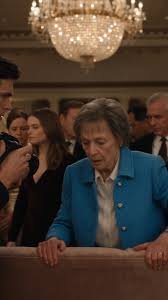
I stood near the entrance wearing the same soft blue jacket Madison once said ruined the picture.
Daniel noticed immediately.
“You did that on purpose.”
“Absolutely.”
He laughed.
Then he pointed toward the first wall.
My portrait of his mother and him hung there.
Beside it was a short story about the session.
No mention of free charity.
I insisted.
His mother deserved dignity, not pity.
Across the gallery hung factory workers.
Families.
Neighborhood children.
Weddings.
Old storefronts.
People whose names I thought nobody remembered.
Visitors stopped me constantly.
Some recognized relatives.
Some recognized themselves.
One elderly woman touched a portrait and cried.
“That’s my brother.”
He had died twenty years earlier.
I stood with her.
No words were needed.
That was my work.
Not glamorous.
Not fashionable.
But real.
Madison arrived late.
Not because of indifference.
Traffic.
She texted me repeatedly.
I smiled at that.
Michael came alone.
Lauren did not attend.
Ruth wore red.
Daniel Reeves carried no camera initially.
He wanted to experience the exhibit first.
Then the museum director gathered us for a photograph.
My stomach tightened.
A family portrait.
Not exactly.
A community portrait.
Daniel picked up his camera.
People assembled.
Ruth.
Michael.
Madison.
Former subjects.
Archivists.
Museum staff.
Then Daniel looked at me.
“Evelyn.”
“Yes?”
“Center.”
I laughed.
“No.”
“Center.”
Madison stepped aside immediately.
“Grandma.”
She touched my arm gently.
“Please.”
I walked toward the center.
Nobody shoved me.
Nobody complained about my jacket.
Michael stood on one side.
Madison on the other.
Daniel raised his camera.
Then lowered it.
My heart stopped for half a second.
He smiled.
“Everyone comfortable?”
We laughed.
He raised the camera again.
Before pressing the shutter, Madison whispered.
“Grandma?”
“What?”
“I’m sorry about the other picture.”
I looked at her.
“I know.”
“I wish we had one from that night with you in it.”
I thought about the velvet platform.
The humiliation.
The camera lowered in protest.
“No.”
She looked surprised.
“I don’t.”
“Why?”
“Because some pictures should not exist.”
Daniel heard me.
He smiled.
Then he took the photograph.
The shutter clicked.
Once.
Twice.
Three times.
Afterward, he showed me the back screen.
I stood in the center.
Silver hair.
Blue jacket.
Black-stone ring.
Visible.
Michael looked nervous beside me.
Madison looked emotional.
Nobody looked perfect.
It was beautiful.
The museum later asked whether they could include that photograph in future materials.
I agreed.
On one condition.
No retouching my wrinkles.
The curator laughed.
“I wouldn’t dare.”
Good.
My wrinkles had earned copyright protection too.
Michael continued repaying me.
So did his company through negotiated licensing restitution.
I did not bankrupt him.
I did not rescue him.
There is a difference.
He eventually closed Carter Printing.
Not because of me alone.
The business had struggled for years.
He found a salaried job managing production for another firm.
At first, he considered that failure.
Then he discovered weekends.
Health insurance.
Vacations.
Predictable sleep.
Sometimes losing an identity saves a person from defending it forever.
Lauren and Michael divorced.
Madison stayed close to both.
I refused to become ammunition between them.
Lauren apologized once through a letter.
She admitted knowing about the licensing.
She admitted encouraging Michael to keep the money because she considered my archive “family assets.”
That phrase almost made me laugh.
She also admitted something harder.
She had spent years editing me socially.
Shorter visits.
Different clothing.
Fewer stories.
Less visible seating.
Why?
“You reminded me that Michael had a life before me.”
I found that sad.
Not flattering.
Just sad.
I never resumed a close relationship with Lauren.
We remained civil.
That was enough.
Madison’s wedding happened the following spring.
She asked me to arrive early.
I did.
She had changed many things.
Smaller guest list.
Less theatrical decor.
No velvet platform.
Then she showed me the family portrait plan.
