

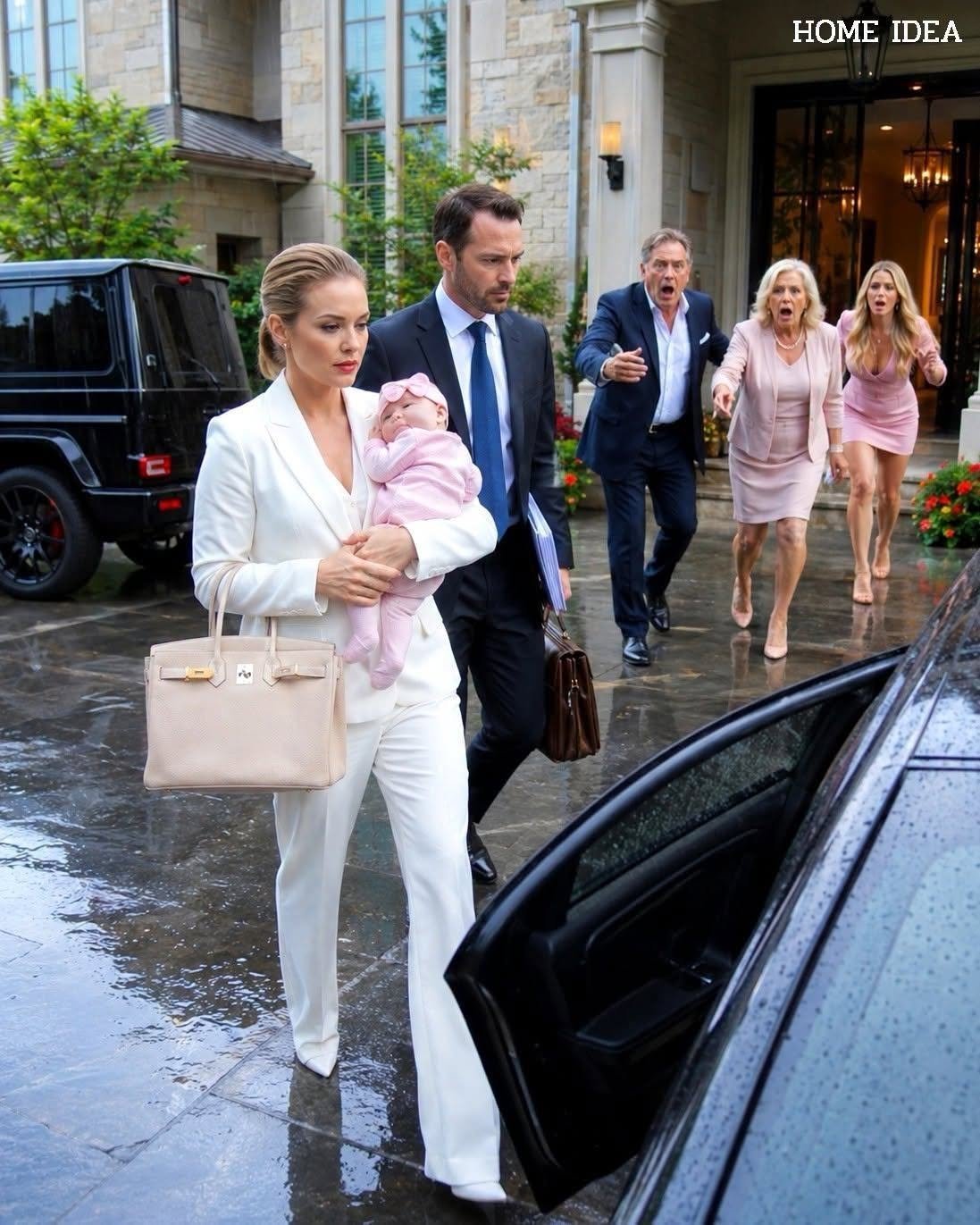
At nine thirty, Jennifer called again.
“I filed an emergency notice preserving your rights to the property,” she said. “Brent has no legal authority to exclude you, change access, dispose of belongings, or represent himself as owner.”
“Will that matter while he’s in Miami?”
“It matters because there will be a record. Also, Elliot wants to meet tomorrow morning.”
Elliot Mercer was the real estate broker who had once handled private sales for several of my clients. He was discreet, patient, and impossible to impress.
“Tomorrow?”
“Cash buyers like this don’t wait long,” Jennifer replied. “But Tess, I need to ask something. Are you selling because you want to, or because you’re hurt?”
I looked toward the bassinet Molly had placed beside the bed. Ivy’s tiny fist rested against her cheek.
“I’m selling because I finally understand what that house became,” I said. “A stage Brent used to perform success. I don’t want my daughter raised inside someone else’s performance.”
Jennifer was quiet for a beat. “Then I’ll be there at nine.”
After we hung up, Molly appeared in the doorway with two mugs.
“Do you remember,” she asked, “the winter Dad left?”
I nodded. I had been twelve, Molly seventeen. Our father had packed one suitcase and promised to return after a business trip. He returned only for the divorce hearing.
“You stopped talking for almost a week,” Molly said. “Then one morning you came downstairs and made pancakes. Burned every single one. Mom cried anyway because you were trying.”
I looked down at my tea.
“You’ve always rebuilt from the kitchen outward,” Molly continued. “A house is only safe when the people inside it are safe. Redwood Crest stopped being safe.”
The words settled over me, painful and true.
That night, I did not sleep much. Newborns have their own mysterious clocks, and Ivy woke every two hours, hungry and furious at the world. Each time, Molly appeared before I called, bringing water, fresh cloths, or silent company.
At dawn, my phone lit up with Brent’s name.
I stared at it until it stopped.
A message followed.
The code change was temporary. Don’t be dramatic. Mom thought you needed rest without visitors. We’ll talk when I’m back.
Molly read it over my shoulder and made a sound under her breath.
“Don’t answer,” she said.
“I wasn’t going to.”
But my hands shook anyway.
At nine, Jennifer arrived in a navy coat with a leather folder pressed to her chest. Elliot came ten minutes later, silver-haired and calm, carrying no visible judgment. He congratulated me on Ivy first. Then he placed a thin packet on Molly’s dining table.
“The buyer is prepared to close quickly,” he said. “No financing contingency. No inspection delay beyond standard review. They’re offering twelve percent above the last appraisal.”
Molly’s eyebrows lifted.
Jennifer looked at me. “That is a serious offer.”
“Who is the buyer?” I asked.
Elliot hesitated.
I noticed. Jennifer noticed too.
“It’s a private trust,” he said. “The representative signed a confidentiality agreement.”
“I’m not selling my house to a ghost.”
“Of course not. You have the right to review the purchasing entity before signing.”
Jennifer opened the packet. Her expression shifted almost imperceptibly as she read the name.
“What?” I asked.
She passed the page to me.
The buyer was listed as Northstar Family Trust.
I frowned. “I’ve never heard of it.”
Molly leaned closer. “Northstar? Like Mom’s necklace?”
A memory flickered: our mother standing at the kitchen sink, touching the small star pendant she wore when she thought no one was looking. She had called it her north star. I had never asked why.
Jennifer’s gaze sharpened. “Tessa, did your mother ever mention a trust?”
“No.”
“Any relatives with that name?”
“No.”
Elliot adjusted his glasses. “The trust’s attorney asked that their interest be handled quietly. They specifically requested first right of refusal if you ever chose to sell.”
My skin prickled.
“Requested when?”
“Two years ago.”
The room fell silent.
Two years ago, I had been happily married, or believed I was. I had not considered selling Redwood Crest. Brent had been charming then, attentive in public, mildly resentful in private whenever my success entered the room before his.
“Who knew I owned the house outright?” I asked.
“Your attorney. Your accountant. Your husband, if you told him. The county records, technically,” Jennifer said. “But a request like that suggests someone was watching the property.”
Molly’s face had gone pale. “Or watching you.”
I pushed the papers away.
For the first time since the lockout, the house itself was no longer the center of the story.
Jennifer reached across the table. “Tess, you don’t have to sign today.”
I looked at the offer, then at Ivy sleeping in her portable bassinet near the window. Her tiny chest rose and fell with complete trust.
“I want to meet the trust’s representative.”
Elliot nodded slowly. “I can ask.”
“Today.”
He made the call from Molly’s porch.
While he spoke, my phone rang again. Diane.
I declined.
A text arrived immediately.
Brent says you are creating unnecessary embarrassment. A wife should not make business decisions while emotional. When we return, we expect this nonsense to be finished.
I read it twice, not because it surprised me, but because the old version of me would have explained herself. She would have softened the edges, made peace easier for everyone else, and swallowed the insult to avoid a scene.
I typed one sentence.
All future communication should go through Jennifer.
Then I blocked Diane’s number.
Molly grinned. “There she is.”
But I did not feel triumphant. I felt tired, sad, and free in a way that still frightened me.
Elliot came back inside with an odd expression.
“The representative agreed,” he said. “Five o’clock today. Their office downtown.”
Jennifer closed her folder. “I’ll come with you.”
“No,” I said, surprising myself. “I want you nearby, but I need to hear whatever this is without feeling like I’m already in a legal battle.”
Molly crossed her arms. “Then I’m coming.”
I almost argued. Then Ivy sighed in her sleep, and I remembered I no longer had to prove strength by standing alone.
At five, Molly drove us through downtown Boulder under a sky the color of pewter. Ivy stayed with a neighbor Molly trusted, a retired nurse named Grace who had the calm hands of someone who had seen everything and panicked at nothing.
The office was on the fourth floor of a modest brick building, not the glass tower I expected. A woman in her sixties greeted us in the lobby. She had silver hair pinned neatly at the nape of her neck and eyes that searched my face with startling familiarity.
“Tessa Vale?” she asked.
“Yes.”
“I’m Nora Whitcomb. I represent the Northstar Family Trust.”
Her voice was professional, but her hands trembled slightly when she offered me a seat in the conference room.
Molly sat beside me like a guard dog in human form.
Nora placed a folder on the table but did not open it.
“Before we discuss the property,” she said, “I owe you context.”
“That would be helpful.”
She drew a breath. “The trust was established by Eleanor Vale.”
My mother’s name landed in the room like a glass dropped on stone.
Molly straightened. “Our mother?”
Nora looked at her. “Yes.”
“That’s not possible,” I said. “Mom died with medical debt and a car that barely started.”
“I understand why you would believe that.”
The room seemed to narrow around me.
Nora opened the folder and slid forward a copy of a document bearing my mother’s signature. I knew that signature. Elegant, slanted, a little impatient at the end.
“This trust was created before your mother’s final illness,” Nora said. “It was not large at first. Over time, certain assets were recovered and placed under protection.”
“Recovered from where?” Molly asked.
Nora’s eyes moved to me. “From your father’s business dealings.”
My mouth went dry.
Our father had always been a closed door in our family history. After the divorce, our mother spoke of him only when necessary. He sent birthday cards until I turned sixteen, then silence. We heard rumors later that he had moved overseas, started another company, married someone younger.
“Why wouldn’t Mom tell us?” I asked.
“Because the assets were disputed. Because she was afraid he would return if he knew she had secured anything. And because there were conditions in place.”
“What conditions?”
Nora folded her hands. “The trust was designed to become visible to you only under specific circumstances.”
Molly gave a humorless laugh. “Like being locked out of your own house with a newborn?”
Nora’s expression softened. “Like attempting to sell Redwood Crest.”
I stared at the document.
“My mother knew about my house?”
“She knew you would build something of your own. She did not know what shape it would take. Years after her death, the trust monitored public filings connected to both of you. When Redwood Crest was purchased in your name, the trustees flagged it.”
“Trustees?” I asked. “Who are they?”
Nora paused too long.
Jennifer would have noticed the pause. So did Molly.
“Nora,” I said carefully, “who controls the trust?”
“I manage its legal administration. The acting trustee is someone your mother appointed.”
“Who?”
Before Nora could answer, her phone vibrated on the table. She glanced at it, and every bit of color left her face.
“I’m sorry,” she said. “I need one moment.”
“No,” Molly said. “You need to answer my sister.”
Nora looked at me, not Molly.
“The trustee asked to be present for that conversation,” she said.
“Then where are they?”
Her gaze drifted to the frosted glass wall behind me.
The conference room door opened.
For one impossible second, I thought grief had finally bent reality.
The man standing there had my father’s eyes.
Not similar eyes. His eyes. Deep-set, gray-green, shadowed at the corners. He was younger than my father would have been, maybe early forties, wearing a dark coat and an expression that held both hope and apology.
Molly rose so fast her chair scraped the floor.
“Who are you?” she demanded.
The man looked at me.
“My name is Adrian Vale,” he said. “And I think your mother meant for me to find you before now.”
I could not speak.
Vale.
The name I had carried like a scar and a shield.
Nora stood. “Adrian is the acting trustee.”
Molly’s voice sharpened. “Why does he have our last name?”
Adrian looked down at the folder in Nora’s hands. “Because I’m your father’s son.”
The room went utterly still.
Not our father, then. Not a ghost. A brother.
Half brother, my mind supplied automatically, as if classification could make the floor steady again.
I sat back down before my legs failed me.
Adrian took a cautious step forward. “I didn’t know about either of you until six years ago.”
Molly laughed once, brittle and disbelieving. “Convenient.”
“It’s true,” he said. “I was raised in Vancouver. My mother died when I was twenty. I found documents later, including letters from Eleanor.”
“My mother wrote to you?” I asked.
“Not to me. To my mother. She warned her about our father.”
The words opened something old and dark. Our father had not simply left one family, perhaps. He had scattered lives like papers and walked away before anyone could gather them.
Nora slid another document toward me. “Eleanor suspected there were other children affected by your father’s financial conduct. Adrian helped recover part of what was taken from her.”
Molly stayed standing, arms locked across her chest.
“Why not contact us?”
