

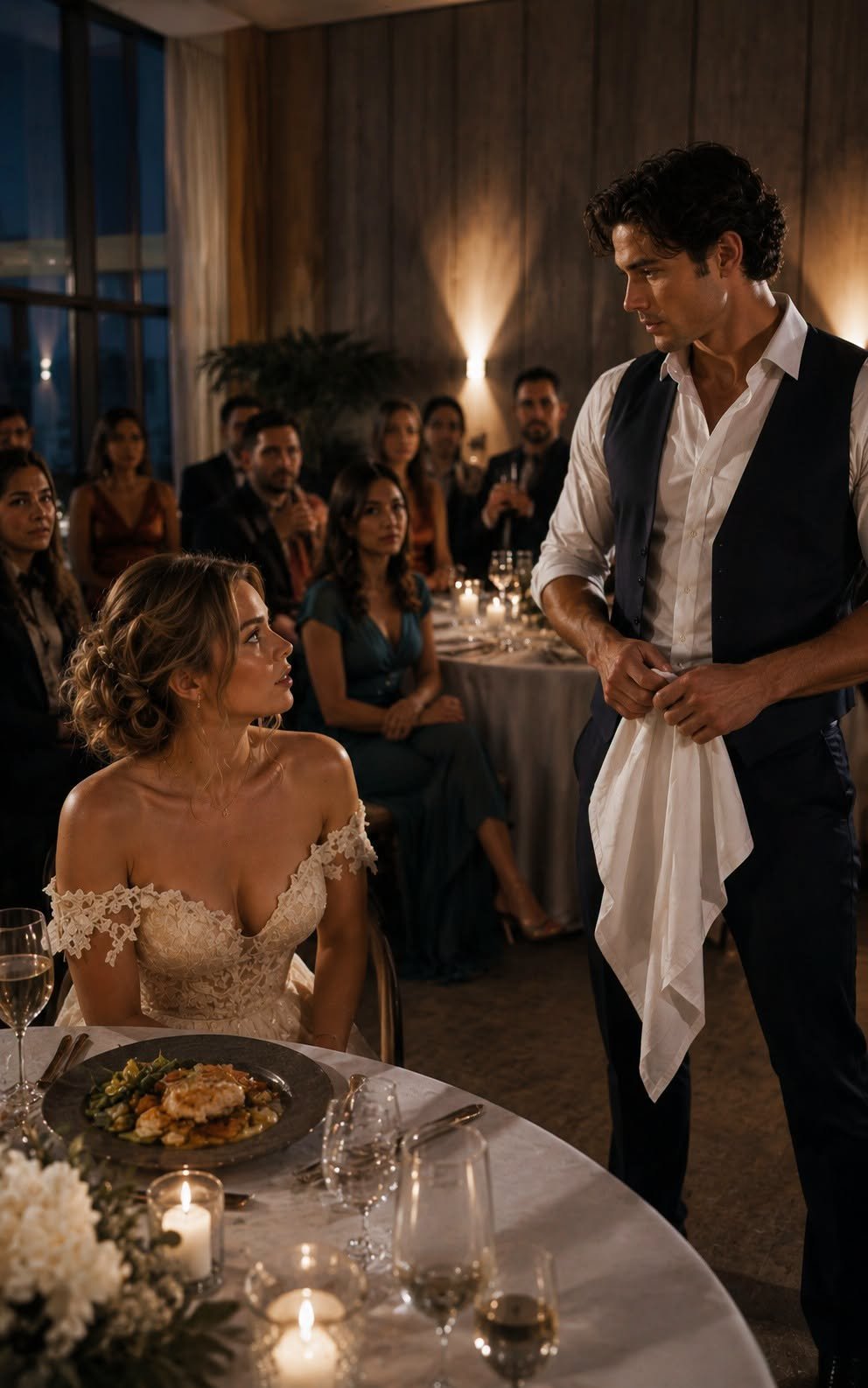
Martin Cole walked past, his eyes fixed straight ahead as his leather shoes clicked against the tile.
By eleven o’clock, the rain had stopped against the high windows, leaving only the quiet dripping of the oak trees outside.
The side exit door clicked, and Dana stepped into the ballroom, her heels echoing against the empty walls.
She was still wearing her bridesmaid dress, though she had taken off her satin shoes and held them in one hand.
In her other hand, her phone screen was glowing bright in the dim room.
“Madison, you need to look at this right now,” Dana said, her voice high and energetic.
She sat in the gold chair next to me and tapped her fingernails against the screen.
“I turned my phone off hours ago,” I said, twisting my bare finger again. “I didn’t want to see the messages from Tyler’s mother.”
“It is not Tyler’s mother,” Dana said, turning the screen toward me. “Look at the local community page.”
On the screen was a crisp photograph of me sitting alone at the giant head table, my face pale under the chandeliers.
The caption underneath read, *The eighty-seat dinner party for one at White Oak Manor.*
“Who took that?” I asked, my voice barely a whisper.
“The post already has six hundred shares,” Dana said, her thumb scrolling through the comments. “People are laughing, Maddie.”
I stared at the reflection of the glass door in the background of the photo, recognizing the angle.
“Tyler’s cousin was standing by the side exit when the ceremony was cancelled,” I said.
“He had his phone out the whole time,” Dana said, her anger clear in her tight jaw. “We need to get you out of this place before someone else comes by with a camera.”
Eli walked back into the room, carrying a fresh linen napkin to replace the one I had dropped.
Martin Cole followed close behind him, his arms crossed over his chest.
“The midnight deadline is approaching, Miss Price,” Martin said, his voice regaining its formal chill. “We must begin turning off the main chandeliers.”
Dana stood up, her phone still glowing with the viral post.
“Look at what people are doing to her online,” Dana said, thrusting the screen toward Martin. “Do you want your venue associated with this kind of cruelty?”
Martin looked down at the screen, his eyes scanning the photograph and the rising view count.
He stood in silence for a long moment, his fingers hovering over his silver cuffs.
“We pride ourselves on the privacy of our clients,” Martin said quietly.
“Then let us stay until the contract hour,” I said, looking Martin directly in the eyes. “My father paid for every minute of this room, and I am not going to hide in my apartment just because someone took a picture.”
Martin looked from me to Eli, who was still holding his wooden clipboard flat against his chest.
“Eli,” Martin said, his voice softer than before. “You may assist Miss Price with her dinner until the midnight hour.”
Martin turned and walked toward the lobby, leaving the heavy oak doors open behind him.
“He didn’t fire you,” Dana said, looking at Eli in surprise.
“He knows what it means to stand your ground,” Eli said.
He set his wooden clipboard down on the table, then picked up his serving tray.
“I am not leaving this table until you are ready,” Eli said.
Eli set down his tray and pulled out a chair next to Madison.
Eli adjusted his black cotton apron and rested his forearms on the white linen tablecloth. He pointed toward the high vaulted ceiling, where dozens of small spotlights were recessed into the dark oak beams.
“You see how those lights are angled from the corners,” he said, his voice slow and deliberate. “They do that so the shadows do not fall across the centerpieces when the guests sit down. If the light comes from directly above, every rose on the table casts a dark circle on the cloth.”
“I did not know there was a science to it,” I said. My thumb traced the bare skin of my ring finger, twisting the empty space where the gold band had lived for eighteen months.
“It is all seconds and inches,” Eli said. “If the kitchen is three minutes late with the salads, the beef dries out under the warming lamps in the back. Then the band has to play an extra song to keep people from noticing the kitchen is behind schedule. The coordinator signals the waiters with a small hand gesture, and we slow down the wine service.”
He explained how a grand venue like White Oak Manor required twenty-two people just to keep the water glasses filled and the dessert plates cleared on schedule. He spoke with the quiet authority of someone who had spent his weekends memorizing the service manuals for his hospitality degree.
“I study the management side of this at the university during the week,” Eli said, his clipboard resting against his chest like a shield. “At night, I carry the trays. Most of the people who come through those double doors do not even look at my face when they order their drinks. They look at the black cotton, or they look right through me like I am part of the drywall.”
“I know how that feels,” I said, thinking of my nursing clinicals. “Some patients treat the student nurses like we are just there to empty the bins and change the sheets.”
He nodded, his eyes fixed on the empty chairs across from us. “But when you run an event, you see everything. You see who is arguing in the corner, who is checking their watch, and who is sneaking out early. You learn to read the room before anyone even speaks.”
“How many did my father pay for?” I asked, looking at the long, empty row of silver forks.
“Fourteen,” Eli said. “And every one of them was standing by the kitchen doors at five o’clock. We had the prime rib in the ovens, and the salads were already plated on the cold racks.”
“I wonder if they ate the food,” I said, thinking of the eighteen thousand four hundred dollars my father had drawn from his retirement account.
“Some of it,” Eli said. “Loretta hates to waste anything. But most of the prime rib had to be wrapped and stored. Once it is cooked to medium-rare, you cannot serve it again the next day.”
He stopped talking when the heavy oak doors at the back of the ballroom creaked open.
I stood up and walked toward the lobby, needing to clear the dry taste of cold bread from my mouth.
Martin Cole was waiting near the registration desk, his fingers busy adjusting the stiff gold-rimmed links on his left cuff. The lobby was quiet, the only sound being the low hum of the beverage cooler behind the bar.
“Mrs. Price,” he said, his voice flat and precise. “It is nearly a quarter to twelve.”
“I know what time it is, Mr. Cole,” I said, stopping a few feet from his desk.
“Our contract states that any event extending past midnight incurs an automatic overtime fee of twenty-four hundred dollars,” he said, looking at the grandfather clock in the corner. “The cleaning crew is scheduled for midnight, and if they have to wait, we pay them double-time. That is the policy of White Oak Manor. Our reputation depends on the ballroom being pristine by sunrise.”
He paused, his eyes shifting to the empty hallway behind me, as if expecting my father or Tyler to emerge from the shadows.
“However, if you are able to vacate the premises within the next fifteen minutes, I am prepared to reduce that penalty to fifteen hundred dollars,” he said, adjusting his collar.
“My father paid eighteen thousand four hundred dollars for a reception that never happened,” I said. “We did not use the band, we did not use the bar, and we did not use the service staff for more than an hour.”
